






Is Your New Car Automatically Covered by Your Existing Auto Insurance?
Driving a new car off the dealership lot is exciting — but if you haven’t contacted your insurance company yet, you may be taking a serious legal and financial risk. According to the National Highway Traffic Safety Administration (NHTSA), approximately 40,990 people died in U.S. traffic crashes in 2023, with California accounting for roughly 3,900 of those fatalities. A gap in your auto insurance — even one that lasts a single day — can expose you to crippling liability if you are involved in an accident before your new vehicle is properly covered. Knowing how California’s automatic coverage rules work is the first step in protecting yourself and everyone who depends on you.
Key Takeaways
- Most California auto insurers provide an automatic grace period of 14 to 30 days for newly purchased vehicles, but coverage terms vary by insurer and policy language.
- California Vehicle Code § 16020 requires every driver to maintain proof of financial responsibility at all times — including the day you purchase a new vehicle.
- If you are injured in an accident involving an uninsured driver or a coverage dispute, California law provides legal pathways to recover compensation — but acting quickly is essential.
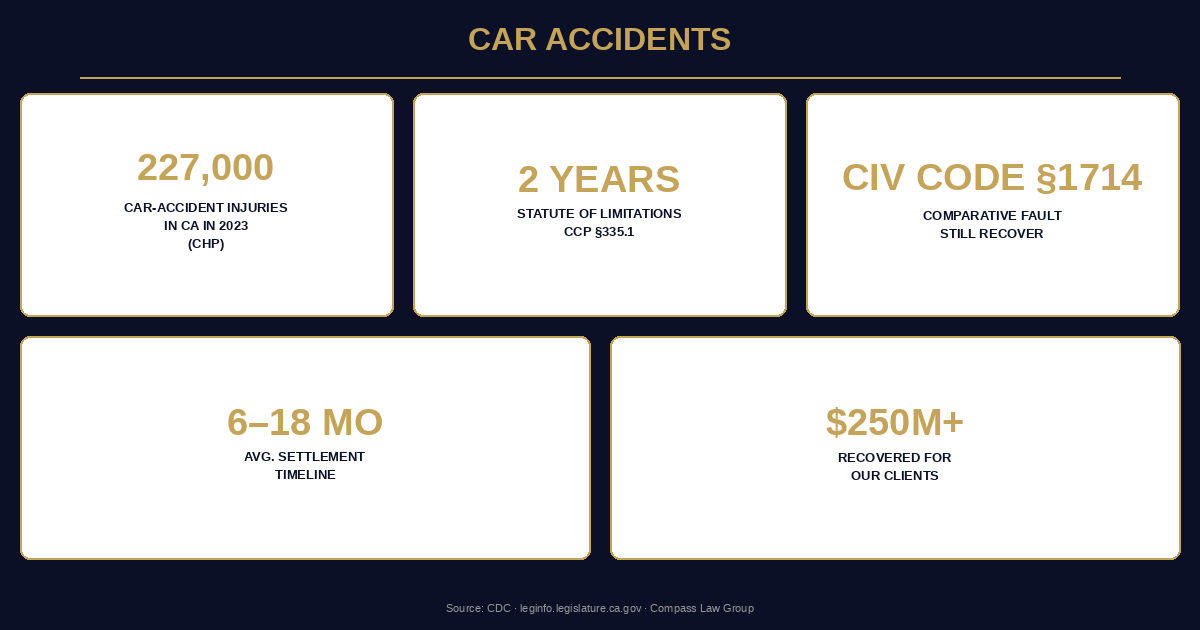
- Compass Law Group, LLP has recovered more than $250 million for California accident victims with no upfront fees and a free consultation for every new client.
What Does California Law Require for Auto Insurance on a Newly Purchased Vehicle?
California law does not carve out exceptions for new car buyers. Under California Vehicle Code § 16020, every operator of a motor vehicle on a public road must maintain proof of financial responsibility at all times. This obligation attaches the moment you take possession of a newly acquired vehicle — regardless of whether you have notified your insurer or visited the DMV. The good news is that most major insurers build an automatic new-vehicle extension into their standard policies precisely to bridge this gap, but that extension is a contractual right, not a statutory guarantee.

As of January 1, 2025, California’s minimum liability requirements increased under Senate Bill 1107 to $30,000 for bodily injury per person, $60,000 per accident, and $15,000 for property damage — collectively known as 30/60/15. These new minimums replaced the decades-old 15/30/5 limits that had remained unchanged since 1967. While most insurers automatically extend these minimums to a newly acquired vehicle during the grace period, many buyers discover after an accident that their new vehicle — especially if financed or leased — required higher limits or additional coverage types not included in that automatic extension.
If you are involved in an accident in a new vehicle and your coverage is disputed, working with an experienced car accident lawyer is essential. California insurers scrutinize new-vehicle coverage disputes closely to minimize payouts, and understanding both your contractual rights under your policy and your statutory rights under California law is critical to protecting your claim from the start.
How Long Does Your Existing Policy Automatically Cover a New Car?
The grace period for newly acquired vehicles is not mandated by California statute — it is a contractual provision that varies by insurer. In practice, most California auto insurers provide automatic coverage for 14 to 30 days from the date you take legal possession of the new vehicle. Some policies extend coverage for as few as four days; others offer a full 30-day window. A smaller number of carriers require you to notify them before or on the day of purchase for automatic coverage to apply at all.

According to Joseph Shirazi, Managing Partner at Compass Law Group in Los Angeles, “The most common mistake we see is drivers assuming the grace period is longer than their policy actually allows. By the time they remember to call their insurer, the window may have already closed — and they’ve been driving uninsured for days without knowing it.”
The type of purchase matters as well. If you are replacing an existing vehicle by trading it in, the grace period may hinge on whether your old car remains on the policy during the transition. If you are adding a second vehicle to your household fleet rather than replacing one, the grace period may be shorter and some policies require advance notice. The safest practice in every situation is to call your insurance agent the same day you take delivery, ask for written confirmation of the grace period dates, and request formal addition of the new vehicle to your policy immediately.
What Types of Coverage Transfer Automatically — and Which Might Not?
Not all coverage types follow a new vehicle at the same level or under the same conditions. Understanding which protections transfer automatically and which require a proactive call to your insurer can prevent a costly and potentially devastating gap. Here is how California auto insurance typically handles a newly acquired vehicle:
- Bodily injury liability — Almost always transfers automatically during the grace period; this is the foundational coverage required by California Vehicle Code § 16020 and the first type extended to a newly acquired vehicle under most policies.
- Property damage liability — Transfers automatically in most California policies alongside bodily injury liability; required by law and generally included in any automatic new-vehicle coverage extension.
- Uninsured/underinsured motorist (UM/UIM) coverage — Generally extends during the grace period under California Insurance Code § 11580.2, which requires insurers to offer UM/UIM protection; essential given that approximately 1 in 6 California drivers carries no insurance.
- Collision coverage — Typically transfers if your existing policy already includes it; however, lenders and lessors almost universally require collision as a condition of financing or leasing, so if your previous vehicle did not carry collision, you must add it before driving the new car off the lot.
- Comprehensive coverage — Usually extends during the grace period if it exists on your current policy; most lenders require it as a loan condition, making it critical to confirm before leaving the dealership.
- Medical payments (MedPay) coverage — Varies significantly by carrier; some California insurers extend it automatically while others require the new vehicle to be formally added before MedPay applies.
- Gap insurance — Does NOT transfer automatically under any standard policy; gap coverage must be purchased separately and is especially important for new vehicles, which can lose 15 to 20 percent of their value within the first year, leaving financed buyers exposed if the vehicle is totaled.
- Rental reimbursement coverage — Typically does not extend automatically to a newly acquired vehicle and must be added when you formally update your policy with the new car’s details.
If you were injured in an accident where the other driver’s coverage was inadequate — or where your own new vehicle’s coverage was disputed — our Los Angeles personal injury lawyers at Compass Law Group can help you challenge the insurer’s position and fight for the full compensation you deserve.
Who Is Liable When an Insurance Gap Results in a Car Accident?
California’s at-fault system means the driver who caused the crash bears financial responsibility for all resulting injuries and property damage — regardless of whether that driver, or you, has adequate insurance coverage. But coverage gaps profoundly complicate how compensation is actually recovered, and the consequences can be permanent.

Free Confidential Consultation — Compass Law Group, LLP | Car Accidents
One of the most consequential insurance laws in California is Proposition 213. Under California’s Proposition 213 and how it affects your car accident claim, a driver operating a vehicle without valid insurance at the time of an accident — even if the other driver was entirely at fault — may be permanently barred from recovering non-economic damages such as pain and suffering, emotional distress, and loss of enjoyment of life. This bar applies even if the driver genuinely believed they were still within an active grace period. The financial and legal stakes of an undetected coverage gap are severe and cannot be undone after the fact.
If you carry UM/UIM coverage and the at-fault driver is uninsured or underinsured, your own insurer steps in to compensate you up to your policy limits. If neither party has adequate coverage, a direct personal injury lawsuit against the negligent driver may be your only avenue. Understanding how long after a car accident you can claim injury in California is a critical first step in preserving your rights. Our Bell Gardens personal injury lawyers at Compass Law Group handle complex coverage disputes throughout Southern California and can identify every available pathway to compensation when insurance becomes contested.
California Car Accident Statistics
The following data illustrates the scale of California’s traffic safety crisis and why proper insurance coverage — and swift legal action after a crash — matter so much for every driver in the state.
40,990 — The number of people killed in U.S. traffic crashes in 2023, according to NHTSA’s Fatality Analysis Reporting System. California alone accounted for approximately 3,900 of those deaths, making it one of the most dangerous states in the country for motorists and passengers. Motor vehicle crashes remain a leading cause of injury-related death across all age groups, according to the Centers for Disease Control and Prevention (CDC).
16.6% — The estimated percentage of California drivers who are uninsured, according to the Insurance Research Council’s most recent study. That means roughly 1 in 6 vehicles on California roads carries no liability insurance whatsoever. Crashes involving uninsured drivers cost the U.S. economy billions of dollars annually, with the financial burden often shifting to insured drivers through UM/UIM claims and increased premiums.
$30,000 / $60,000 / $15,000 — California’s new statutory minimum liability limits as of January 1, 2025, under Senate Bill 1107. Many accident victims — particularly those with serious injuries requiring surgery, hospitalization, or long-term rehabilitation — find that even these updated minimums fall far short of covering their actual losses, reinforcing the importance of carrying higher limits and UM/UIM coverage on every vehicle in your household.
15–20% — The estimated value a new vehicle loses within its first year of ownership, according to automotive industry data from leading vehicle valuation firms. Without gap insurance, drivers who finance a new car and experience a total-loss accident may owe thousands more on their loan than the insurance payout covers — a financial trap that is entirely preventable with the right coverage in place from day one.
How Does Compass Law Group Help Accident Victims Navigate Insurance and Coverage Disputes?
Insurance disputes involving new vehicles, coverage gaps, and uninsured motorist claims are among the most legally complex situations any California accident victim can face. Compass Law Group, LLP — with offices in Beverly Hills, Los Angeles, Long Beach, San Francisco, Sacramento, Oakland, and Bell Gardens — has the resources and litigation experience to fight back when insurers attempt to deny or minimize legitimate claims.
Our attorneys, Joseph Shirazi (California Bar #265403) and Simon Esfandi (California Bar #275307), have recovered more than $250 million for injured Californians across a wide range of personal injury practice areas, including complex auto insurance litigation, UM/UIM disputes, and cases involving Proposition 213 defenses raised by at-fault parties. Our California car accident attorneys handle every aspect of your case — from gathering and preserving evidence immediately after the crash to negotiating with adjusters and filing suit in California Superior Court when insurers act in bad faith or refuse to honor valid claims.
We work exclusively on a No Win, No Fee basis. If we do not recover compensation for you, you owe us nothing. Every new client receives a free, confidential consultation with an experienced attorney who will evaluate your specific coverage situation, explain your legal options under California law, and help you understand what your claim may realistically be worth. We also regularly publish in-depth resources on our legal blog to help California accident victims make informed decisions at every stage of the claims process.
Q: Does my existing auto insurance automatically cover my new car in California?
Yes, in most cases. The majority of California auto insurance policies include a new-vehicle automatic coverage provision that extends your current coverage to a newly acquired vehicle for a grace period typically ranging from 14 to 30 days. However, the exact grace period length and which coverage types are included vary by insurer and policy language. You should contact your insurance company on the same day you take possession of your new vehicle to confirm coverage, document the grace period terms in writing, and formally add the vehicle to your policy before the window closes.
Q: What if I get into an accident the day I buy my new car before calling my insurer?
If your policy includes an automatic new-vehicle provision and you are within the stated grace period, you are likely covered for the accident — with coverage generally mirroring what you carry on your existing insured vehicle. If your policy requires advance notification or your grace period had already expired, you may face a coverage dispute. Contact your insurer immediately after the accident, request a copy of your policy’s new-vehicle provision, and consult a California car accident attorney before speaking with the at-fault driver’s insurer or signing any release documents.
Q: Do I need additional insurance if I financed or leased my new car in California?
Not necessarily a separate policy, but you almost certainly need additional coverage types beyond California’s minimum requirements. Lenders and lessors typically require both collision and comprehensive coverage as a condition of financing or leasing. If your existing policy only carries minimum liability coverage, those additional types will not automatically transfer. You must add them before driving the financed vehicle. Gap insurance, which covers the difference between what you owe on the loan and the vehicle’s actual cash value in a total-loss situation, also does not transfer automatically and must be purchased separately.
Q: How long do I have to file a lawsuit after a car accident in California?
Under California Code of Civil Procedure § 335.1, you generally have two years from the date of the accident to file a personal injury lawsuit — regardless of how long your insurance claim takes to resolve. If the accident involved a government vehicle or occurred on government property, the deadline is significantly shorter: a government tort claim must be filed within six months of the incident. Missing either deadline permanently eliminates your right to sue. An experienced California personal injury attorney can evaluate your specific timeline and ensure all critical deadlines are identified and met well in advance.
Q: What can I do if the driver who hit my new car had no insurance?
Your first option is to file a claim under your own uninsured motorist (UM) coverage. California Insurance Code § 11580.2 requires California insurers to offer UM/UIM coverage to all policyholders, and if you accepted it, your insurer compensates you for medical bills, lost wages, and pain and suffering up to your policy limits. If you declined UM/UIM coverage or your limits are insufficient, you may still have a direct civil lawsuit against the uninsured driver, though collecting on that judgment can be challenging. A California car accident attorney can identify all available sources of compensation and manage the process for you.
No Win, No Fee — Compass Law Group, LLP | Call (213) 320-1001
Source: Compass Law Group | Car Accidents
Steps to Take After a Car Accident Involving a New Vehicle
Whether your accident occurred during your policy’s coverage grace period or after you updated your coverage, these steps protect both your physical recovery and your legal rights. Our clients across Bell Gardens, Sacramento, and throughout California have followed this process to secure the compensation they deserved.
- Call 911 immediately if anyone is injured. Emergency medical care is the top priority. A police report documenting the crash, the parties involved, insurance information, and any observed fault indicators is essential evidence for your insurance claim and any future personal injury lawsuit.
- Document the scene thoroughly before anything is moved. Photograph all vehicles, visible injuries, road conditions, skid marks, traffic controls, and surrounding property. Collect the other driver’s full name, license number, insurer, and policy number. If there are witnesses, gather their contact information.
- Notify your insurer the same day as the accident. Report the crash to your insurance company promptly — even if you were not at fault. Confirm with your insurer that coverage applies to your new vehicle and ask them to note the effective dates of your grace period in writing.
- Formally add your new vehicle to your policy immediately. If you have not yet updated your policy with the new vehicle’s details, do so right away and request written confirmation of the effective date and covered types. Do not delay this step even if your claim is already open.
- Preserve all evidence and medical documentation. Save every medical bill, prescription receipt, diagnostic record, repair estimate, and communication from insurance adjusters. Photograph your injuries periodically over time and maintain a daily log of symptoms, limitations, and missed activities.
- Confirm whether gap insurance applies if the vehicle was totaled. If your new car was financed and declared a total loss, determine immediately whether gap coverage exists through your insurer, the dealership’s financing arm, or your lender to avoid being left with a loan balance that exceeds the insurance payout.
- Consult a California car accident attorney before accepting any settlement offer. Insurers often extend fast, low offers before the full scope of injuries is known. Knowing California’s deadline for filing an injury claim is critical — learn about California’s filing deadline for car accident injury claims before making any decisions that could permanently affect your rights.
Get Your Free Consultation Today
If you were injured in a California car accident involving an insurance dispute, a coverage gap, or an uninsured driver, the attorneys at Compass Law Group, LLP are ready to fight for the maximum compensation you deserve. No Win, No Fee — your first consultation is always free.