






Fatal Tour Bus Fire on the 60 Freeway in Hacienda Heights: What the Carrier’s Federal Safety Record Shows
Federal roadside records for the company that operated the bus show a 26.3 percent vehicle out-of-service rate across 19 inspections in the 24 months ending August 20, 2026, against a 22.26 percent national average printed on the same government page (Federal Motor Carrier Safety Administration, SAFER Company Snapshot, USDOT 2017905). Early Friday morning, August 21, 2026, a charter bus carrying 18 passengers from Southern California to Mexico caught fire on the shoulder of the eastbound 60 Freeway in Hacienda Heights, and one passenger did not get off.
Key Takeaways
- CHP responded to the fire at about 5:38 a.m. on Friday, August 21, 2026, on the eastbound 60 Freeway near Azusa Avenue in Hacienda Heights. The driver reported mechanical difficulties, pulled to the shoulder, and then saw smoke coming from the rear of the bus.
- The driver and passengers evacuated. After the fire was out, crews found one unaccounted-for passenger dead on board. The Los Angeles County Medical Examiner identified her as Marina Diaz de Pacheco, 89.
- The operator, Viajes Azteca LLC of East Los Angeles (USDOT 2017905), holds a Satisfactory federal safety rating dated September 20, 2024 — and, over the last 24 months of roadside data, six emergency-exit violations and four fire-extinguisher violations.
- No cause has been determined, and nothing published ties those inspection findings to the bus that burned. Both facts matter, and neither should be stated as more than it is.
An 89-year-old passenger was killed when a Viajes Azteca charter bus bound for Mexico caught fire on the eastbound 60 Freeway shoulder in Hacienda Heights at about 5:38 a.m. on August 21, 2026. The driver and 17 other passengers escaped. The cause of the fire remains under investigation by the California Highway Patrol.
What happened in the 60 Freeway tour bus fire in Hacienda Heights?
According to a CHP press release described by ABC News, the Mercedes bus experienced “mechanical difficulties” while traveling east on State Route 60. When the driver pulled onto the shoulder, he “observed smoke emitting from the rear of the vehicle.” The driver and passengers evacuated as the bus caught fire. When crews extinguished the blaze, they located an unaccounted-for passenger dead on board.
FOX 11 reported that CHP responded to the fire at about 5:38 a.m. near Azusa Avenue, that multiple eastbound lanes closed for the investigation, and that all lanes reopened by about 11 a.m. ABC7 reported that more than half of the bus burned, that 18 people were aboard including the driver, and that a passenger, Ofelia Ramos, believed the woman who died had been sitting toward the back and may have been asleep.

NBC4 Los Angeles later reported that the Los Angeles County Medical Examiner identified the person who died as Marina Diaz de Pacheco, 89, that the charter was traveling from Southern California to Mexico, and that the fire appeared to start at the rear of the bus. Video from the scene showed passengers standing on the shoulder beside their luggage.
Why do the first reports of this bus fire disagree with each other?
Because early collision reporting is assembled from a CHP incident log, a press release and eyewitnesses, all of which are written before anyone has finished looking. The headline on the first ABC7 story said westbound lanes were closed; the body of that same story, and every other outlet, placed the bus on the eastbound side. FOX 11 put two lanes closed and reopened by 11 a.m.; ABC News said two lanes remained closed at the time it published.
These are ordinary discrepancies, and they are worth naming for one reason: the same process that produces a wrong compass direction in a headline also produces early, confident-sounding statements about cause. In a fire case, the cause statement is the whole case. A family reading coverage in the first 48 hours should treat direction, timing and mechanism as provisional until CHP releases its report.
What does the bus company’s federal safety record actually show?
The operator has been identified in reporting as Viajes Azteca. The FMCSA carrier with that name is Viajes Azteca LLC, USDOT 2017905, at 4714 E Olympic Blvd in East Los Angeles — consistent with ABC7’s report that the company is based in East L.A. We pulled the federal record directly rather than relying on any summary of it. As of the August 20, 2026 snapshot, the carrier operates five power units with 14 drivers, is authorized for interstate for-hire passenger service, and carries a Satisfactory safety rating with a rating date of September 20, 2024.
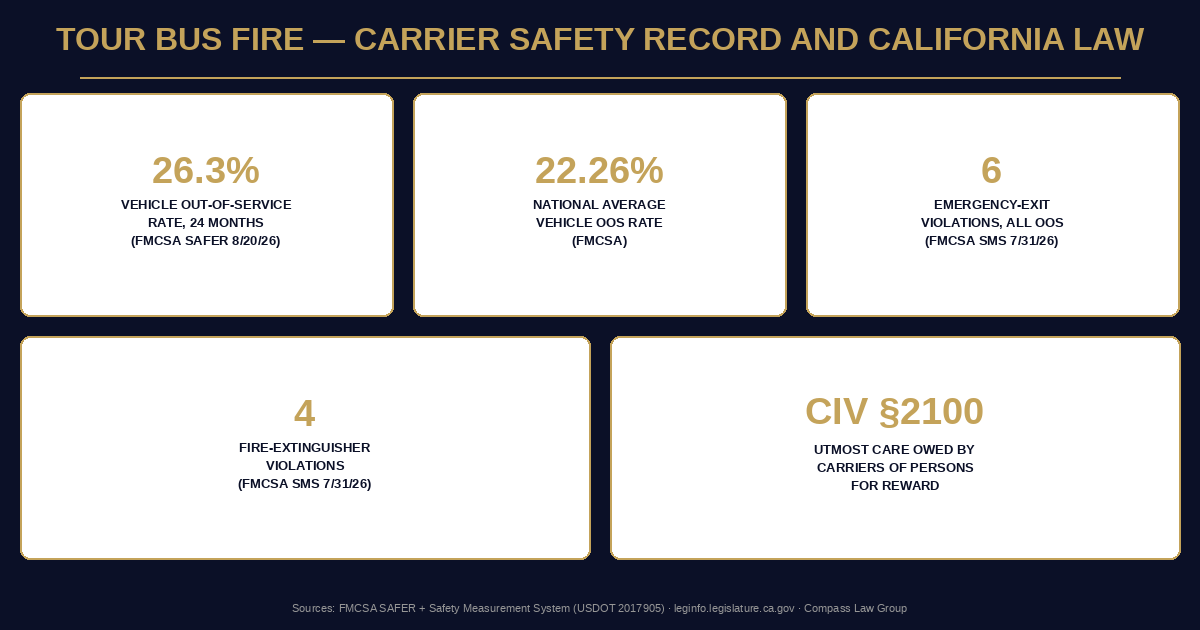
The rating is only half the picture, because a safety rating reflects the last compliance review while roadside inspections keep happening afterward. Over the 24 months ending August 20, 2026, FMCSA logged 19 vehicle inspections of this carrier’s buses and placed five out of service — a 26.3 percent vehicle out-of-service rate against the 22.26 percent national average printed on the same page. FMCSA reported zero crashes for the carrier over that window.
The Safety Measurement System profile for the same USDOT number, current to July 31, 2026, itemizes the violations behind those inspections:
| Federal rule | Violation | Count | Out of service |
|---|---|---|---|
| 49 CFR 393.62-BEMEI | Marked emergency exit inoperative | 4 | 4 |
| 49 CFR 393.62-BEI | Required emergency exit inoperative | 1 | 1 |
| 49 CFR 393.62-BENM | Required emergency exit not properly marked | 1 | 1 |
| 49 CFR 393.95(a)(4)-EEUS | Fire extinguisher unsecured | 3 | 0 |
| 49 CFR 393.95(a)(4)-EENA | Fire extinguisher not readily accessible or filled | 1 | 0 |
| 49 CFR 396.9(c)(2)-OOSO | Operating after an out-of-service order without completing repairs | 1 | 0 |
| 49 CFR 396.9(d)(2)-FTF | Failing to correct defects noted on a roadside inspection report | 1 | 0 |
One inspection carries most of that weight. On April 17, 2026, a single roadside inspection of one of the carrier’s motor coaches produced an inoperative marked emergency exit, a required exit that was not properly marked, a fire extinguisher that was not readily accessible or filled, an unsecured fire extinguisher, a citation for operating after an out-of-service order without completing repairs, and a citation for failing to correct defects from a previous inspection report. FMCSA lists no enforcement penalties against the carrier in the six years to August 21, 2026.
What that record does not establish. These are fleet-wide roadside results across several vehicles. Nothing published identifies the bus that burned on August 21 as any of the buses in those inspections, and no cause of the fire has been determined. A carrier can have a poor out-of-service rate and a fire that had nothing to do with it. The record is a reason to ask specific questions in a specific investigation — not an answer.
What duty does a bus company owe its passengers under California law?
A far higher one than an ordinary driver owes. California Civil Code § 2100 states in full: “A carrier of persons for reward must use the utmost care and diligence for their safe carriage, must provide everything necessary for that purpose, and must exercise to that end a reasonable degree of skill.”
Three phrases in that sentence do the work. Utmost care and diligence is the highest standard of care California imposes on a private business. Must provide everything necessary for that purpose reaches equipment — working exits, accessible extinguishers, maintained systems — not just careful driving. And for reward means the duty attaches because passengers paid, which a charter bus carrying ticketed travelers plainly does. The same rules that make a bus accident case different from a car case are why a burn case against a carrier is investigated differently from one against a private motorist.
Who can be held responsible after a fatal motorcoach fire?
More parties than most families expect, and the answer depends on physical evidence that degrades quickly. The realistic candidates in a bus fire are:
- The motor carrier — for maintenance, inspection and repair practices, for how it responded to prior out-of-service findings, and for driver training on evacuation.
- The manufacturer of the bus or a component — if a design or manufacturing defect in the engine compartment, wiring, fuel or battery system started or spread the fire. This is a product liability question, and in California it does not require proof of carelessness, only a defect that caused harm.
- A repair or maintenance vendor — if outside work on the systems that failed was done improperly.
- A parts supplier — if a specific component was defective or subject to a recall that went unperformed.
Which of those matters is decided by the burned vehicle itself. The bus was hauled away at about midday on the day of the fire. Once a burned motorcoach is released to an insurer or a salvage yard, the wiring harness, the fuel and battery systems, the extinguisher brackets and the exit hardware can be cut up, scrapped or altered, and the origin-and-cause question becomes an argument between experts working from photographs. A written preservation demand sent early is the single cheapest thing a family can do.
What can a family recover after a passenger dies on a bus?
California splits the recovery into two tracks. A wrongful death claim under Code of Civil Procedure § 377.60 belongs to specified surviving family members and covers what they lost — financial support, funeral and burial expenses, and the loss of the decedent’s love, companionship, comfort, care, assistance, protection, affection, society and moral support. A separate survival action belongs to the estate and covers what the decedent herself lost before death. Which relatives have standing, and how the two claims are pleaded together, is the first thing our Los Angeles wrongful death attorneys work out with a family.
Passengers who escaped are not bystanders in a legal sense either. Smoke inhalation, burns and the psychological injury of a survived fire are all compensable, and the burn injury claims of surviving passengers frequently develop from the same evidence as the fatality claim. Families of passengers on the Hacienda Heights bus, and passengers who got off it, are served by our Los Angeles office.
Source: Compass Law Group | FMCSA SAFER + SMS (Aug 2026), Cal. Civ. Code §2100
How does Compass Law Group help after a California bus fire?
The first week decides most of what is provable later. Our work in that window is unglamorous and time-sensitive: send spoliation letters to the carrier, its insurer and whoever is storing the bus; retain an origin-and-cause fire investigator to examine the vehicle before it is cut up; demand the carrier’s maintenance file, prior inspection reports and repair records for that specific vehicle identification number; obtain the driver’s qualification file and hours-of-service data; and preserve the CHP investigation materials and any freeway or dashcam video.
We then compare what the carrier’s own records say about that bus against what FMCSA’s roadside data says about the fleet. That comparison is where a fleet-wide statistic either becomes evidence about this vehicle or is honestly set aside. It is the same discipline we applied to an explosive big rig fire on the I-5, where the fuel system drove the severity of the outcome, and to a fatal Metro bus collision in Santa Monica. Families working with our Los Angeles bus accident attorneys pay nothing unless we recover.
Steps to Take After a Bus Fire or Motorcoach Injury in Los Angeles County
- Get evaluated, even if you walked away. Smoke inhalation and airway injury can present hours later, and the medical record created that day is the one that ties the injury to the fire.
- Write down what you saw while it is fresh. Where you were sitting, what you smelled or heard first, which exit you used, whether it opened, and how long it took to get off.
- Photograph everything you still have. Your ticket or booking confirmation, damaged belongings, your injuries, and any photos or video from the shoulder.
- Get the names and numbers of other passengers. On a charter to another country, witnesses scatter across a border within days.
- Ask for the CHP traffic collision report number and keep it with your records.
- Do not give a recorded statement to the carrier’s insurer before you have talked to your own lawyer, and do not sign anything releasing a claim.
- Move quickly on the bus itself. Preservation of the burned vehicle is the one step that cannot be done late.
Our thoughts are with Marina Diaz de Pacheco’s family and with every passenger who got off that bus. We will update this post as CHP releases findings.
This post is based on CHP statements reported by ABC News, ABC7, FOX 11 and NBC4 Los Angeles, on the Los Angeles County Medical Examiner identification reported by NBC4, and on FMCSA SAFER and Safety Measurement System records retrieved on August 22, 2026. The cause of the fire has not been determined and details may change as the investigation continues.
Frequently Asked Questions
Where and when did the 60 Freeway tour bus fire happen?
The California Highway Patrol responded to a bus fire on the eastbound Santa Ana Freeway (State Route 60) near Azusa Avenue in Hacienda Heights at about 5:38 a.m. on Friday, August 21, 2026. The bus was stopped on the right shoulder. Multiple eastbound lanes were closed for the investigation and all lanes reopened by about 11 a.m.
Who was killed in the Hacienda Heights bus fire?
The Los Angeles County Medical Examiner identified the person who died as Marina Diaz de Pacheco, 89. According to CHP, the driver and the other passengers got off the bus and fire crews found one unaccounted-for passenger dead on board after they put the fire out. Eighteen passengers were on the bus, which was traveling from Southern California to Mexico.
What caused the tour bus fire?
No cause has been determined. CHP said the driver reported mechanical difficulties while traveling east, pulled onto the shoulder, and then saw smoke coming from the rear of the vehicle. NBC4 reported that the fire appeared to start at the rear of the bus. The investigation was still open as of August 22, 2026, and nothing published so far establishes why the bus caught fire.
Does the bus company have a satisfactory federal safety rating?
Yes. FMCSA’s SAFER Company Snapshot for Viajes Azteca LLC, USDOT 2017905, of East Los Angeles, shows a Satisfactory carrier safety rating with a rating date of September 20, 2024, current as of August 20, 2026. A Satisfactory rating reflects the last compliance review, not the condition of any particular bus on any particular morning.
What do the carrier’s roadside inspection records show?
In the 24 months ending August 20, 2026, FMCSA recorded 19 vehicle inspections of the carrier’s buses, five of which put a vehicle out of service — a 26.3 percent vehicle out-of-service rate against a 22.26 percent national average printed on the same FMCSA page. FMCSA’s Safety Measurement System profile lists six emergency-exit violations under 49 CFR 393.62 and four fire-extinguisher violations under 49 CFR 393.95(a)(4) over the same window. Those findings are fleet-wide roadside results. Nothing published identifies the bus that burned as one of the buses inspected.
What standard of care does a bus company owe its passengers in California?
California Civil Code section 2100 provides that a carrier of persons for reward must use the utmost care and diligence for their safe carriage, must provide everything necessary for that purpose, and must exercise to that end a reasonable degree of skill. That is a higher standard than the ordinary reasonable-care standard that applies to most drivers.
How long does a family have to bring a claim after a fatal bus fire?
California Code of Civil Procedure section 335.1 gives two years from the date of death to file a wrongful death lawsuit, and section 377.60 defines who may bring one. Shorter deadlines can apply if a public entity is involved. Because deadlines are case-specific and can be shortened by facts a family does not know yet, a family should have the deadline confirmed by a lawyer rather than assume the two-year date applies.

If you were on that bus, or you lost someone who was, you are entitled to answers that do not depend on the carrier’s version of events. A free consultation costs nothing and puts someone to work preserving the evidence while it still exists. We handle bus and motorcoach cases on contingency, which means no fee unless we recover for you. If your family is more comfortable speaking Spanish, tell us when you call and we will make that arrangement before the conversation starts.
Get Your Free Consultation Today
Injured or bereaved in a Los Angeles County bus fire? Compass Law Group will preserve the evidence and pursue full compensation — No Win, No Fee. Call now or request a free, confidential review.
References
- FMCSA SAFER Company Snapshot — Viajes Azteca LLC, USDOT 2017905 (data as of August 20, 2026)
- FMCSA Safety Measurement System — Complete SMS Profile, USDOT 2017905 (data as of July 31, 2026)
- NBC4 Los Angeles — 89-year-old woman killed in 60 Freeway bus fire in Hacienda Heights (August 21, 2026)
- ABC7 Los Angeles — 1 killed after fire engulfs tour bus on 60 Freeway in Hacienda Heights (August 21, 2026)
- FOX 11 Los Angeles — 1 dead in 60 Freeway tour bus fire in Hacienda Heights (August 21, 2026)
- ABC News — 1 passenger dead after fire erupts on tour bus on California freeway (August 21, 2026)
- California Civil Code § 2100 — carriers of persons for reward
- California Code of Civil Procedure § 377.60 — wrongful death standing