



On Wednesday, August 26, 2026, a motorcyclist was killed on the southbound 405 Freeway in Sherman Oaks. The crash was reported at about 11:15 a.m. near Burbank Boulevard and the transition to the 101 Freeway, and the California Highway Patrol said the rider was pronounced dead at the scene. Multiple southbound lanes were closed, causing significant traffic backups. As of publication the rider had not been publicly identified, and the CHP has not determined how the crash occurred.
The reporting on that point differs. ABC7 Los Angeles reported that the rider fell from the motorcycle and was then struck by other vehicles. CBS Los Angeles reported plainly that it is unclear how the crash occurred, noting only skidmarks behind the motorcycle in the far-left lane near the center median. Those are two different accounts of the same minutes, and neither is a finding — the CHP investigation is what will establish the cause, if it can be established at all.
Source: Compass Law Group | Motorcycle Accidents on Los Angeles Freeways: Rider Rights After a 405 Crash

We are writing about this because Southern California riders and their families ask the same questions every time a freeway crash makes the news, and the answers are hard to find when you need them most. What follows is general information about rider rights in California after a freeway motorcycle collision. It is not a description of this incident, this rider, or this family, and nothing here should be read as a claim about who was at fault.
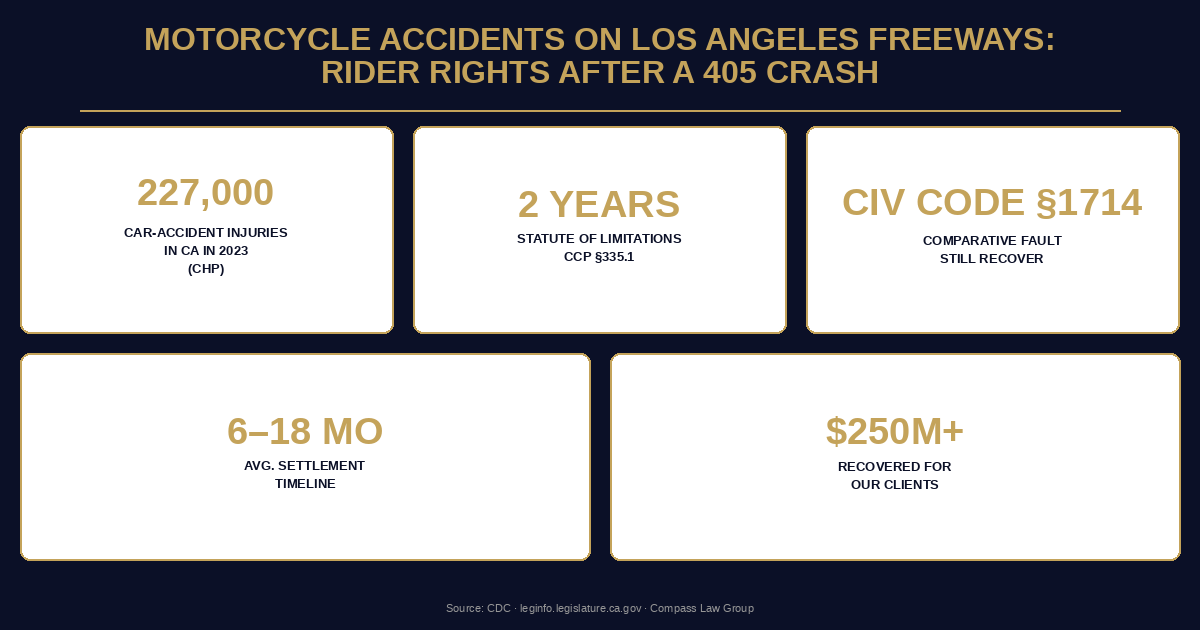
- California gives most injured riders and surviving families two years from the date of the crash to file a lawsuit, and as little as six months to file a claim when a public entity may be responsible.
- A rider who was partly at fault can still recover money. California uses pure comparative negligence, which reduces an award by the rider’s percentage of fault rather than barring it.
- Freeway evidence is perishable — vehicles are released from tow yards, event data recorders overwrite, and Caltrans and business camera footage is routinely deleted within days or weeks.
- When the cause is genuinely unknown, the investigation is the case. Independent reconstruction, roadway-condition evidence, and vehicle inspection often answer questions a traffic report leaves open.
A rider injured in a Los Angeles freeway motorcycle crash — or a family that lost someone — generally has two years under California law to file suit. Fault is decided by evidence, and California’s comparative negligence rule allows recovery even when a rider is partly at fault.
What Makes Freeway Motorcycle Crashes Different From Surface-Street Collisions?
A motorcycle collision on the 405, the 101 or the 5 is a different event from the same collision on Ventura Boulevard, and the difference shows up in every part of the claim that follows.
The first difference is physics. Freeway traffic moves at highway speed, and a rider has no crumple zone, no airbag and no restraint. A fall that would produce bruises in a parking lot produces catastrophic injuries at 65 miles per hour, and the rider is often thrown into an active travel lane where other drivers have no time to react. Injuries that follow freeway crashes are disproportionately severe: traumatic brain injury even when a helmet is worn, spinal cord damage, degloving and road-rash injuries requiring grafts, multiple fractures, and internal bleeding. Families frequently need a lawyer who understands the medical trajectory of a serious head injury as much as they need one who understands traffic law, because the future cost of care is often the largest single number in the case.
The second difference is jurisdiction. Crashes on California freeways are investigated by the California Highway Patrol, not by LAPD or a city police department. That means the traffic collision report comes from a state agency, on a state timeline, and it is typically not available to the public for days or weeks after the crash. Families calling a city police station for a report that CHP holds lose time they do not have.
The third difference is the scene itself. A freeway cannot stay closed. Lanes are cleared and reopened as fast as safety allows, vehicles are towed to storage yards, and debris fields are swept away. Within hours, the physical record of what happened exists only in photographs, measurements, skidmark documentation and whatever data the vehicles themselves recorded. On a surface street, a scene can often be revisited. On the 405, it cannot.
The fourth difference is the number of potential witnesses who are simultaneously the most useful and the hardest to find — drivers who saw the crash, kept moving in traffic, and never gave a name to anyone.
Who Can Be Held Liable After a Motorcycle Crash on the 405?
Liability in a freeway motorcycle case is rarely as simple as “the other driver.” California law allows an injured rider or a surviving family to pursue every party whose negligence was a substantial factor in causing the harm, and freeway crashes often involve several.
The most common defendant is another motorist — a driver who changed lanes into a rider’s path, followed too closely, drifted while distracted, or was impaired. In a multi-vehicle sequence, more than one driver may share responsibility: the driver who caused the initial contact and a following driver who struck a rider already down can each be liable for the harm they caused.
Commercial vehicles bring a second layer. When a truck, delivery van, bus or rideshare vehicle is involved, the employer may be responsible for the driver’s conduct, and commercial policies carry far higher limits than personal auto coverage. Those cases also come with records that private drivers do not have — dispatch logs, hours-of-service data, telematics and maintenance histories — which is exactly why a preservation letter needs to go out early.
A third category is the vehicle or the motorcycle itself. A defective tire, a brake failure, a steering component that separates, or a negligent repair can cause a rider to go down with no other vehicle involved. These claims are proven through inspection and engineering analysis of the machine, which is why releasing a motorcycle from a tow yard before it is examined can end a viable case before it starts.
A fourth category is the roadway. Dangerous conditions of public property — pavement defects, unsecured construction zones, debris that a maintaining agency knew about, or a design hazard — can support a claim against a government entity such as Caltrans. These claims follow a separate and much shorter procedural track, discussed below.
Finally, in cases involving impaired driving, California’s dram shop rules are narrow but not nonexistent, and they are worth evaluating rather than assuming. A Los Angeles motorcycle accident attorney can identify which of these paths the facts actually support before the evidence to prove any of them disappears.
How Does California’s Comparative Fault Rule Affect a Rider’s Recovery?
Many riders never call a lawyer because someone told them the crash was partly their fault. In California, that belief costs people compensation they were entitled to recover.
California follows pure comparative negligence. A jury assigns each party a percentage of responsibility, and the injured person’s award is reduced by their own share. A rider found 30 percent at fault recovers 70 percent of the damages. Critically, there is no cutoff: even a rider assigned a majority of the fault still recovers the remaining percentage. This is different from many other states, where being 51 percent at fault ends the claim entirely.
Insurers know this rule well, and it shapes how motorcycle claims are handled. Adjusters routinely argue that a rider was speeding, was lane splitting improperly, was inexperienced, or was wearing gear that “made him harder to see” — not necessarily because the evidence supports it, but because every percentage point shifted onto the rider reduces what the carrier pays. Anti-motorcycle bias is real, and it is often the unstated theory of the defense.
Two California rules come up constantly and are widely misunderstood. First, lane splitting is legal in California; Vehicle Code section 21658.1 authorizes it and directs the CHP to develop safety guidelines. Splitting lanes is not automatically negligent, though the manner and speed of the maneuver can still be evaluated as part of the fault analysis. Second, California requires riders and passengers to wear a helmet meeting federal safety standards under Vehicle Code section 27803. Helmet use is a genuine legal issue in injury cases, but it is not a bar to recovery, and it has no bearing at all on injuries a helmet could not have prevented.
The practical takeaway is that fault is a finding, not an opinion. It is established through physical evidence, reconstruction, vehicle data and witness testimony — not by an adjuster’s first phone call, and not by a rider’s own guess in the days after a traumatic event.
What Happens When the Cause of a Freeway Crash Is Unknown?
Sometimes the initial reporting simply does not answer the question. In the Sherman Oaks case, ABC7 described a rider falling and being struck by other vehicles, while CBS reported that it was unclear how the crash occurred and noted skidmarks behind the motorcycle. Both outlets reported what they had. Neither reported a cause, and CHP has not announced one.
Free Confidential Consultation — Compass Law Group, LLP | Motorcycle Accidents on Los Angeles Freeways: Rider Rights After a 405 Crash
An unknown cause is not the same as no case. It means the investigation has to do the work that a witness statement would otherwise do.
Independent accident reconstruction starts with what the roadway preserved — skid and yaw marks, gouge marks in the pavement, the final rest positions of the motorcycle and any involved vehicles, and the distribution of debris. From those measurements a reconstructionist can often calculate approach speeds, determine the sequence of impacts, and distinguish a rider who lost control on his own from a rider who was contacted by another vehicle.
Vehicle data is the second source. Most modern passenger vehicles carry an event data recorder that captures pre-impact speed, throttle, braking and steering input in the seconds before a crash. That data is powerful, it is finite, and it can be lost when a vehicle is repaired, resold or crushed. Many motorcycles carry electronic control modules with useful data as well.
The third source is video. The 101 and 405 corridors are covered by Caltrans traffic cameras, and the surrounding surface streets carry business security cameras, residential doorbell cameras and an enormous number of dashcams. Most of that footage is overwritten on a rolling cycle measured in days. Sending preservation demands quickly is often the single highest-value step available after a freeway crash.
Finally, roadway conditions themselves get examined: pavement defects, unmarked construction, fallen cargo, or debris left in a travel lane. If a hazard contributed, the maintaining agency may share responsibility — and that possibility is one more reason not to wait for the official report before starting to preserve evidence. Families can begin with the firm’s Los Angeles injury resources while the investigation is still open.
What Damages Can an Injured Rider or a Surviving Family Recover?
California recognizes two broad categories of compensatory damages, and the distinction matters because they are proven in completely different ways.
Economic damages are the measurable financial losses: emergency and ongoing medical treatment, surgeries, rehabilitation, medical equipment, prescription costs, lost wages during recovery, and reduced future earning capacity when injuries prevent a return to the same work. In severe freeway cases these are frequently dominated not by past bills but by the projected cost of future care, which is established through treating physicians and life-care planning rather than through receipts.
Non-economic damages cover physical pain, emotional suffering, disfigurement, and the loss of the ability to do things that made life meaningful — including riding. These are real losses that the law compensates, though they resist arithmetic. Our discussion of what motorcycle accident settlements involve explains why any published “average” is a poor predictor of an individual case: the number turns on injury severity, liability strength, and available insurance coverage, not on a formula.
When a rider dies, California law splits recovery into two claims. A wrongful death claim under Code of Civil Procedure sections 377.60 and 377.61 belongs to the surviving family — typically a spouse, domestic partner, children, or dependent family members — and compensates them for their own losses: financial support the person would have provided, funeral and burial expenses, and the loss of the decedent’s love, companionship, comfort and guidance. Notably, California does not permit surviving family members to recover for the decedent’s pain and suffering in a wrongful death claim itself.
That is instead the subject of a survival action, brought by the estate under section 377.30, which recovers losses the person sustained before death. The two claims are usually filed together, and which family members have standing is a question a wrongful death attorney should evaluate early, because the answer determines who must be included.
Underinsured and uninsured motorist coverage deserves specific attention. Freeway injuries routinely exceed a minimum liability policy, and a rider’s own UM/UIM coverage may be the difference between partial and full recovery.
The documents and records that most often decide these cases include:
- The CHP traffic collision report, including the officer’s diagram, measurements and any statements taken at the scene
- Event data recorder downloads from every involved vehicle, obtained before repair or salvage
- Caltrans, business, residential and dashcam video from the corridor, requested before automatic deletion
- The motorcycle itself, preserved unrepaired for mechanical and defect inspection
- Complete medical records, imaging and treating-physician opinions on permanence and future care
- Employment and wage records establishing lost income and diminished earning capacity
- Every applicable insurance policy — the at-fault party’s, any commercial policy, and the rider’s own UM/UIM coverage
Motorcycle Accidents on Los Angeles Freeways: Rider Rights After a 405 Crash | Source: CDC, CA Legislature | Compass Law Group
Source: Compass Law Group | Motorcycle Accidents on Los Angeles Freeways: Rider Rights After a 405 Crash

How Compass Law Group Builds Your Case
Compass Law Group approaches a freeway motorcycle case as an investigation first and a claim second, because in these cases the facts are not handed to anyone — they have to be recovered.
That work begins with preservation. Letters go out to insurers, tow yards, trucking companies and video custodians to stop the routine destruction of evidence while the family is still in the hospital or making funeral arrangements. Where the mechanism of the crash is contested or unknown, accident reconstruction and vehicle inspection are arranged before anything is repaired or released. Records are gathered in parallel: the CHP report when it issues, complete medical documentation, employment history, and every policy that might apply.
Just as importantly, the firm handles the insurance communications. Adjusters call early and ask for recorded statements while people are medicated, grieving and least able to describe a traumatic event accurately. Riders do not have to take those calls alone, and a case is not strengthened by guessing at facts on the record.
Consultations are free, and the firm works on a contingency fee — no fee unless there is a recovery. Compass Law Group serves riders and families throughout Los Angeles County, including the San Fernando Valley communities along the 405 and 101 corridors.
Deadlines are strict, and some are much shorter than two years. In California, most personal injury lawsuits must be filed within two years of the injury under Code of Civil Procedure section 335.1, and wrongful death claims generally follow the same two-year period running from the date of death. When a government entity may be responsible — including Caltrans for a dangerous roadway condition — the California Government Claims Act requires an administrative claim within six months of the incident before any lawsuit can be filed. Missing a deadline usually ends the claim permanently, regardless of how strong the evidence is. Certain circumstances can shorten or extend these periods, so confirm the deadline that applies to your situation with an attorney rather than assuming the general rule fits.
Does wearing or not wearing a helmet affect my claim in California?
California requires helmets meeting federal safety standards under Vehicle Code section 27803. Not wearing one does not bar a claim, but a defense may argue it contributed to certain head injuries, which could reduce recovery under comparative fault. It has no bearing on injuries a helmet could not have prevented, such as fractures or internal injuries.
Is lane splitting legal, and will it be used against me?
Lane splitting is legal in California under Vehicle Code section 21658.1. Splitting lanes is not negligence by itself. An insurer may still argue that the speed or manner of a specific maneuver was unsafe, which is a factual question decided on evidence — not an automatic finding against the rider.
What if the driver who caused the crash fled the scene?
A hit-and-run does not necessarily end a claim. Uninsured motorist coverage on the rider’s own policy often applies to phantom and unidentified drivers, subject to policy terms and prompt notice requirements. Reporting the incident to law enforcement and to the insurer quickly is important, because delayed notice can jeopardize that coverage.
How long does the CHP investigation take, and should I wait for it?
Traffic collision reports commonly take days to several weeks, and complex fatal investigations take longer. You should not wait to begin preserving evidence. Video is overwritten, vehicles are repaired or salvaged, and witnesses become harder to locate — all on a much faster timeline than the report.
The insurance company already called me. Should I give a recorded statement?
You are not required to give a recorded statement to another driver’s insurer, and doing so before you understand your injuries or the facts of the crash carries real risk. Statements made while medicated or in shock are used later to argue inconsistency or fault. You may decline and refer the adjuster to your attorney.
Who can file a wrongful death claim in California?
Standing is defined by Code of Civil Procedure section 377.60 and generally extends to a surviving spouse or domestic partner, children, and — in their absence — others who would inherit under intestate succession, along with certain dependent family members. Because the categories are specific, determining who must be included is one of the first legal questions in a fatal case.
Steps to Take After a Motorcycle Crash on a Los Angeles Freeway
- Get medical care immediately, and follow through. Adrenaline masks serious injuries, and internal bleeding and head trauma can present hours later. Gaps in treatment are used to argue that injuries were minor or unrelated.
- Report the crash and obtain the CHP report number. Freeway collisions are CHP jurisdiction. The report number is what lets you or your attorney request the report when it is released.
- Photograph everything you safely can. The motorcycle, gear, vehicle positions, roadway surface, debris, skid marks, lighting, and visible injuries. Photograph injuries again as they change over the following weeks.
- Collect contact information from witnesses before they leave. On a freeway, a witness who drives away is usually unfindable. A name and phone number captured at the scene is often the most valuable evidence anyone gathers that day.
- Do not authorize repairs, sale or salvage of the motorcycle. Preserve it unrepaired so it can be inspected for mechanical failure or defect, and find out which tow yard is holding it and what its storage deadline is.
- Notify your own insurer promptly, but decline to give a recorded statement to the other driver’s carrier. Prompt notice protects UM/UIM coverage; an early recorded statement rarely helps you.
- Write down what you remember while it is fresh. Time, location, weather, traffic, what you saw and heard. Memory of a traumatic event degrades quickly and is difficult to reconstruct later.
- Keep every document. Medical bills, discharge instructions, prescriptions, mileage to appointments, pay stubs, and correspondence from insurers.
- Talk to an attorney before deadlines run. This matters most where a government entity may be involved, because the claim window is six months rather than two years.
Get Your Free Consultation Today
No Win, No Fee — Compass Law Group, LLP | Call (213) 320-1001
Injured in a motorcycle crash on a Los Angeles freeway, or lost a family member in one? Compass Law Group offers free, confidential consultations to riders and families across Los Angeles County. There is no fee unless we recover compensation for you, and there is no obligation to hire us after we talk.
Evidence in freeway cases disappears on a schedule that has nothing to do with how ready you feel. If you have questions about deadlines, insurance coverage, or what should be preserved right now, call (310) 289-7126 or reach out through our contact form to speak with our team.
References
- ABC7 Los Angeles, “Motorcyclist killed after falling from bike on SB 405 Freeway in Sherman Oaks, triggering lane closures,” August 26, 2026. https://abc7.com/post/motorcyclist-killed-falling-bike-sb-405-freeway-sherman-oaks-triggering-lane-closures/19740147/
- CBS News Los Angeles, “Motorcyclist killed in crash on 405 Freeway in Sherman Oaks,” August 26, 2026. https://www.cbsnews.com/losangeles/news/motorcyclist-killed-crash-405-freeway-sherman-oaks/