



Fatal Hit-and-Run at Western Avenue and 56th Street: What South L.A. Families Can Do When the Driver Is Never Found
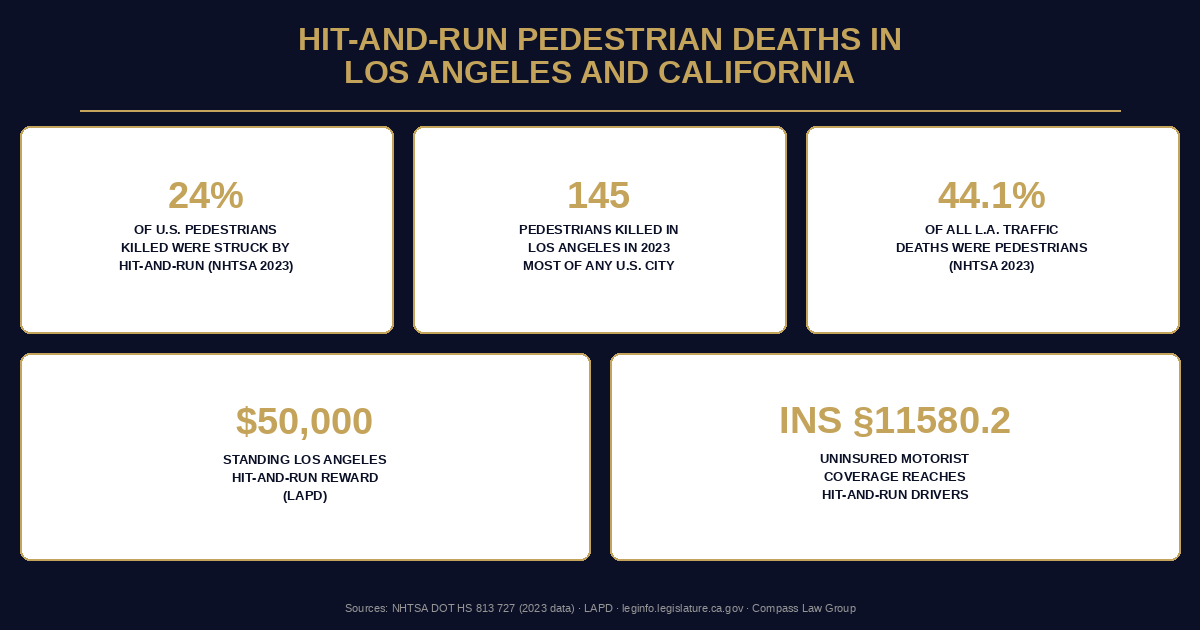
Nearly one in four pedestrians killed on American roads is struck by a driver who does not stop — 24 percent of the 7,314 pedestrian deaths in 2023 (National Highway Traffic Safety Administration, Pedestrians: 2023 Data, DOT HS 813 727). Late on Monday, August 17, 2026, that statistic acquired another name in South Los Angeles. Mark Cooper, 23, and a second pedestrian were struck at Western Avenue and 56th Street by a light-colored sedan whose driver kept going.
Key Takeaways
- LAPD reports an unknown light-colored sedan traveling northbound on Western Avenue struck two pedestrians at 56th Street at about 10:55 p.m. on Monday, August 17, 2026, then fled north on Western.
- The Los Angeles County Medical Examiner identified the man who died as Mark Cooper, 23, on Thursday, August 20. The second pedestrian was severely injured and remained hospitalized.
- Los Angeles carries a standing reward of up to $50,000 for information leading to a hit-and-run driver’s identification, arrest and conviction. LAPD South Traffic Division asked the public to call Officer Hurd at 213-321-9681.
- A driver who is never identified does not automatically mean no recovery. California’s uninsured motorist statute is written to reach exactly this situation — but the deadlines that apply come from an insurance policy, not the two-year rule most people have heard of.
Mark Cooper, 23, was killed and a second pedestrian severely injured when a light-colored sedan traveling northbound on Western Avenue struck them at 56th Street in South Los Angeles at about 10:55 p.m. on August 17, 2026. The driver fled north on Western and had not been identified. LAPD South Traffic Division is investigating.
What do police say happened at Western Avenue and 56th Street?
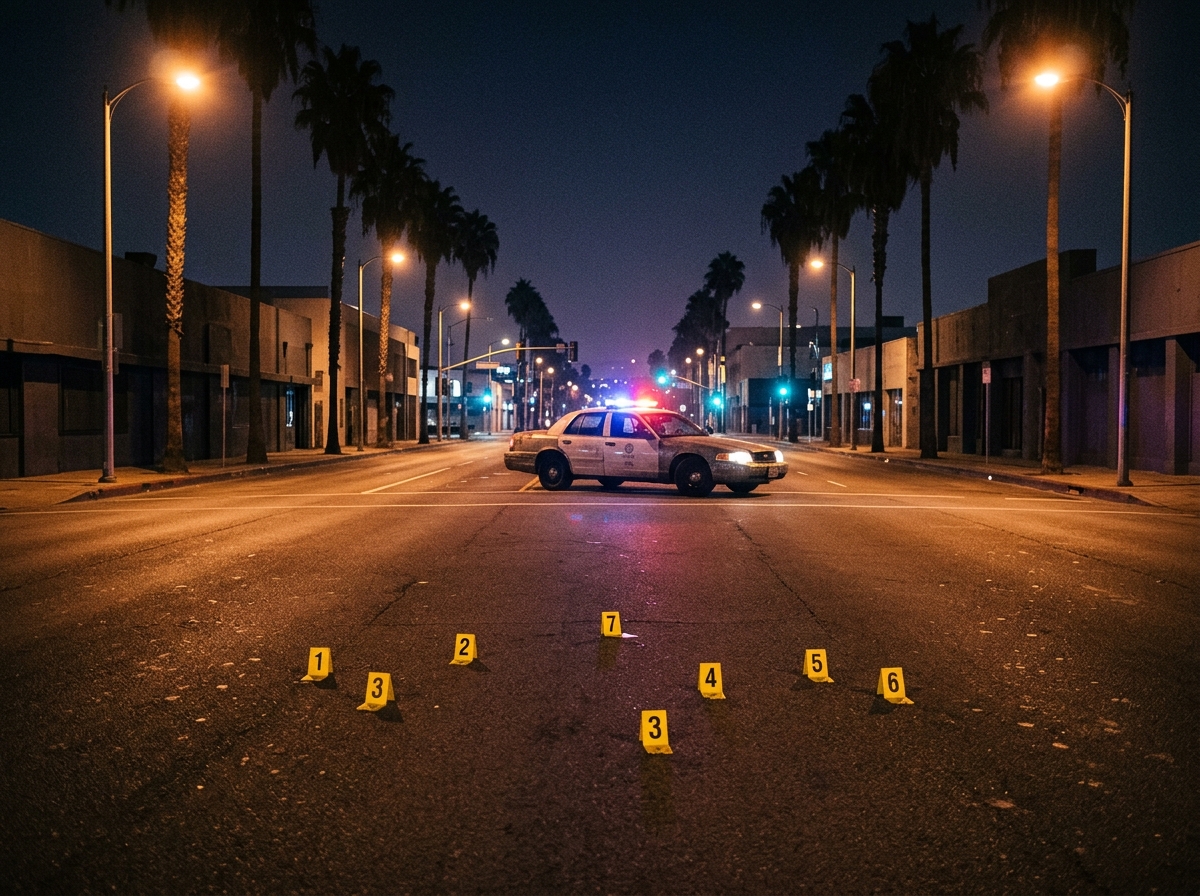
CBS Los Angeles, quoting an LAPD news release, reported that the collision near the intersection of Western Avenue and 56th Street happened at around 11 p.m., when an “unknown light-colored sedan traveling northbound on Western Avenue collided into two pedestrians.” Both victims were taken to a nearby hospital, where one died. The driver left the area still heading north on Western.
MyNewsLA reported the time more precisely as about 10:55 p.m. on Monday, and reported that the Los Angeles County Medical Examiner identified the man who died as 23-year-old Mark Cooper on Thursday, August 20. His city of residence was not released. No description of a suspect or of the vehicle beyond “light-colored sedan” had been made public.

A note on sourcing, because it matters to families reading coverage of their own relative. An account of this collision published by The Legal Advocate carries the same core facts — the light-colored sedan, the 10:55 p.m. time, the two pedestrians, the driver fleeing — and then refers to the person who died as “Ms. Cooper.” The Medical Examiner’s identification and every LAPD-sourced report describe a 23-year-old man. Early aggregated coverage is a starting point for finding sources, not a substitute for them. We link the underlying reports below so anyone can check the record themselves.
Why do so many drivers flee, and why does it matter legally?
Because the reasons people run — being impaired, unlicensed, uninsured, or in a car that is not theirs — are the same conditions that make them worth prosecuting and hard to collect from. That is not speculation about this driver, about whom nothing is known. It is the pattern that shapes how these cases are worked.
Leaving is its own crime. California Vehicle Code § 20001(a) provides that “the driver of a vehicle involved in an accident resulting in injury to a person, other than himself or herself, or in the death of a person shall immediately stop the vehicle at the scene of the accident” and fulfill the duties in sections 20003 and 20004 — identifying themselves and rendering reasonable assistance. That duty does not depend on fault. A driver who was not at fault at all still commits a felony by driving away from a person who is dying in the road.
How dangerous is Los Angeles for people on foot?
More dangerous than any other American city by raw count, and the proportion is the part that should be hard to read past. NHTSA’s Pedestrians: 2023 Data fact sheet records the following:
| Area | Total traffic deaths | Pedestrian deaths | Pedestrian share |
|---|---|---|---|
| United States | — | 7,314 | 18% |
| California | 4,061 | 1,106 (most of any state) | 27.2% |
| Los Angeles, CA | 329 | 145 (most of any city) | 44.1% |
Two more figures from the same publication describe the conditions of this collision almost exactly. Seventy-seven percent of pedestrian deaths in 2023 occurred in the dark, and 74 percent occurred at locations that were not intersections, against 17 percent at intersections. A late-night strike on a wide arterial is the single most common shape this kind of death takes. We have written before about why pedestrian deaths remain high in Los Angeles despite Vision Zero.
What evidence identifies a hit-and-run driver?
Rarely a witness to the plate. Almost always an accumulation of small records that exist for a limited time:
- Private camera footage within a few blocks. Doorbell cameras, corner stores, gas stations, storage yards and buses. Most consumer systems overwrite in seven to thirty days, which is why this is the first thing to chase.
- Vehicle debris left at the scene. A headlight ring, a mirror housing or a grille fragment can identify a make, model and often a model-year range.
- Paint transfer on clothing or on the roadway, which a laboratory can match to a manufacturer’s paint code.
- Body-shop and salvage canvassing. A vehicle with front-end damage has to be repaired, scrapped, or hidden, and each of those leaves a trace.
- Traffic and transit cameras along the escape route — here, northbound Western Avenue — which are held by agencies on their own retention schedules.
Every item on that list has a clock on it. This is the practical reason a family should not wait for the criminal investigation to finish before someone starts working the civil side: a preservation letter sent in week one and a canvass done in week one are worth more than any amount of effort in month six. Our Los Angeles pedestrian accident lawyers run that canvass in parallel with LAPD, not instead of it.
Can a family recover if the driver is never found?
Frequently, yes — and this is the single most misunderstood point in pedestrian accident cases. California Insurance Code § 11580.2 requires that every bodily injury liability policy issued in California contain, or have added by endorsement, uninsured motorist coverage insuring the insured and the insured’s heirs or legal representatives for damages they are legally entitled to recover from the owner or operator of an uninsured motor vehicle. A hit-and-run vehicle is treated as uninsured, because there is no identified insurer to look to.
What surprises people is who that reaches. A pedestrian does not need to have been in a car. Coverage typically follows the person: their own auto policy can respond even though they were on foot, and a resident relative may be covered under a household member’s policy. In a household with two or three insured vehicles, there may be more than one policy to examine.
The catch is the deadline. An uninsured motorist claim is a contract claim, and the notice, proof-of-loss and demand requirements come from the policy language rather than from the two-year rule people have heard of. Some of those requirements are measured in days. Locating every policy that might respond, and giving notice under each of them, is work that has to start immediately — and it is the reason we take these calls before anyone knows whether the driver will ever be caught. We have covered the mechanics in detail in can I be compensated when a California hit-and-run driver isn’t found, and the criminal side in California hit-and-run laws.
Source: Compass Law Group | NHTSA, Pedestrians: 2023 Data (DOT HS 813 727)
How does Compass Law Group help after a South L.A. hit-and-run?
We start with the two clocks that are already running. The first is evidence: within days we canvass for camera footage along Western Avenue and the surrounding blocks, send preservation demands to every business and agency that may hold it, and photograph and document the roadway, lighting and sightlines while conditions still match the night of the collision. The second is coverage: we identify every insurance policy in the household that could respond, put each carrier on notice, and calendar the policy deadlines so none of them lapses while the criminal case is pending. That work is run out of our Los Angeles office, a short drive from the intersection.
Alongside that we obtain the traffic collision report, coordinate with South Traffic Division so the civil work does not cut across the investigation, and — where a surviving pedestrian is still hospitalized — get medical liens and care coordinated so treatment is not interrupted by billing. A severely injured survivor’s brain injury or orthopedic case and the family’s wrongful death claim often share the same evidence and should be worked together, not in sequence. The measure of damages in a wrongful death case is set by statute and is broader than most families expect. Everything is on contingency: no fee unless we recover.
Steps to Take After a Hit-and-Run in Los Angeles
- Call LAPD and get the report number. For this collision, South Traffic Division Detectives can be reached through Officer Hurd at 213-321-9681; anonymous tips go to L.A. Regional Crime Stoppers.
- Ask neighbors and businesses for camera footage within 48 hours and ask them, in writing, to save it. Most systems overwrite within a week or two.
- Photograph the scene at the same hour of night. Lighting, sightlines and traffic volume at 10:55 p.m. are not what they are at noon.
- Locate every auto insurance policy in the household — the victim’s own, and any policy under which they were a resident relative.
- Give written notice to each carrier promptly, before you know whether the driver will be found. Uninsured motorist deadlines run from the policy, not from an arrest.
- Keep every medical record and bill, including ambulance and emergency-department charges from the first night.
- Do not give a recorded statement to any insurer, including your own, before you have spoken with your own lawyer.
Our condolences to Mark Cooper’s family, and our hopes for the recovery of the second pedestrian who is still in the hospital. If you saw anything on Western Avenue that night, LAPD’s number is above and the reward is real.
This post is based on LAPD statements reported by CBS Los Angeles and MyNewsLA, on the Los Angeles County Medical Examiner identification reported by MyNewsLA, and on NHTSA’s Pedestrians: 2023 Data fact sheet, all retrieved on August 22, 2026. The investigation is open and details may change.
Frequently Asked Questions
What happened at Western Avenue and 56th Street?
According to LAPD, an unknown light-colored sedan traveling northbound on Western Avenue struck two pedestrians at 56th Street at about 10:55 p.m. on Monday, August 17, 2026. The driver kept going north on Western. Both pedestrians were taken to a hospital, where one died. The Los Angeles County Medical Examiner identified him on Thursday, August 20, as Mark Cooper, 23. The second pedestrian was severely injured and remained hospitalized.
Is there a reward for information about the driver?
Yes. Los Angeles has a standing hit-and-run reward of up to $50,000, created when the City Council amended the Los Angeles Administrative Code on April 15, 2015 to establish a Hit-and-Run Reward Program Trust Fund. It is paid for information leading to the driver’s identification, apprehension and conviction. LAPD asked anyone with information to contact Officer Hurd of South Traffic Division Detectives at 213-321-9681, or to report anonymously through L.A. Regional Crime Stoppers.
Can a family recover compensation if the hit-and-run driver is never identified?
Often, yes. California Insurance Code section 11580.2 requires uninsured motorist coverage to be offered on every California auto liability policy, and that coverage is written to reach an unidentified driver. A pedestrian is usually covered by their own auto policy, and may also be covered as a resident relative under a household member’s policy, even though they were on foot and not in a car. Whether a specific policy responds depends on its terms and on notice requirements that can be short, so the policies should be reviewed quickly.
How common are hit-and-run pedestrian deaths?
Nearly one in four. NHTSA’s fact sheet Pedestrians: 2023 Data reports that 24 percent of the 7,314 pedestrians killed in U.S. traffic crashes in 2023 were struck by hit-and-run drivers. The same publication records 77 percent of pedestrian deaths occurring in the dark and 74 percent at locations that were not intersections.
How dangerous is Los Angeles for people on foot?
By NHTSA’s 2023 count, Los Angeles had 145 pedestrian deaths — the highest of any U.S. city — out of 329 total traffic deaths in the city. That means 44.1 percent of everyone killed in traffic in Los Angeles in 2023 was a pedestrian. California as a whole recorded 1,106 pedestrian deaths, also the most of any state.
Is fleeing the scene a crime in California?
Yes. Vehicle Code section 20001(a) requires the driver of a vehicle involved in an accident resulting in injury to or the death of another person to immediately stop at the scene and fulfill the duties in sections 20003 and 20004, which include identifying themselves and rendering reasonable assistance. Leaving is a separate crime from whatever caused the collision, and it does not depend on who was at fault.
How long does a family have to bring a civil claim?
California Code of Civil Procedure section 335.1 generally allows two years from the date of death for a wrongful death action, and section 377.60 sets out who may bring one. Uninsured motorist claims are governed by the policy and can carry much shorter notice and demand deadlines. Because the shorter deadline is the one that controls, a family should have both checked rather than rely on the two-year date.

Losing someone to a driver who did not stop leaves a family with grief and no one to direct it at. That is exactly the situation California’s uninsured motorist rules were written for, and the work of proving such a claim starts long before anyone is arrested. A free consultation costs nothing, commits you to nothing, and gets the camera-footage canvass and the insurance notices moving this week rather than next month. If your family would rather speak Spanish, say so when you call and we will arrange it up front.
Get Your Free Consultation Today
Hurt or bereaved by a hit-and-run driver in Los Angeles? Compass Law Group chases the footage, finds the coverage and pursues full compensation — No Win, No Fee. Call now or request a free, confidential review.
Related — October 7, 2026: Another fatal crash on a Los Angeles County road: a Nobu Malibu chef was killed in early October 2026 when an SUV struck his parked car on Pacific Coast Highway. Our report on the Nobu Malibu chef killed on PCH sets out the wrongful death deadlines and damages that apply.
References
- CBS Los Angeles — 1 pedestrian killed, another severely injured by South LA hit-and-run driver, police say (August 18, 2026)
- MyNewsLA — Coroner IDs young hit-and-run victim (August 20, 2026)
- NHTSA — Traffic Safety Facts, Pedestrians: 2023 Data, DOT HS 813 727 (June 2025)
- California Vehicle Code § 20001 — duty to stop at the scene
- California Insurance Code § 11580.2 — uninsured motorist coverage
- California Code of Civil Procedure § 377.60 — wrongful death standing
- Los Angeles Police Department — Traffic Group
- The Legal Advocate — Mark Cooper dies in Los Angeles hit-and-run accident, police report (August 21, 2026)