





Playa del Rey Widower Blames Road Changes for His Pregnant Wife’s Death: How a Claim Against the City of Los Angeles Actually Works
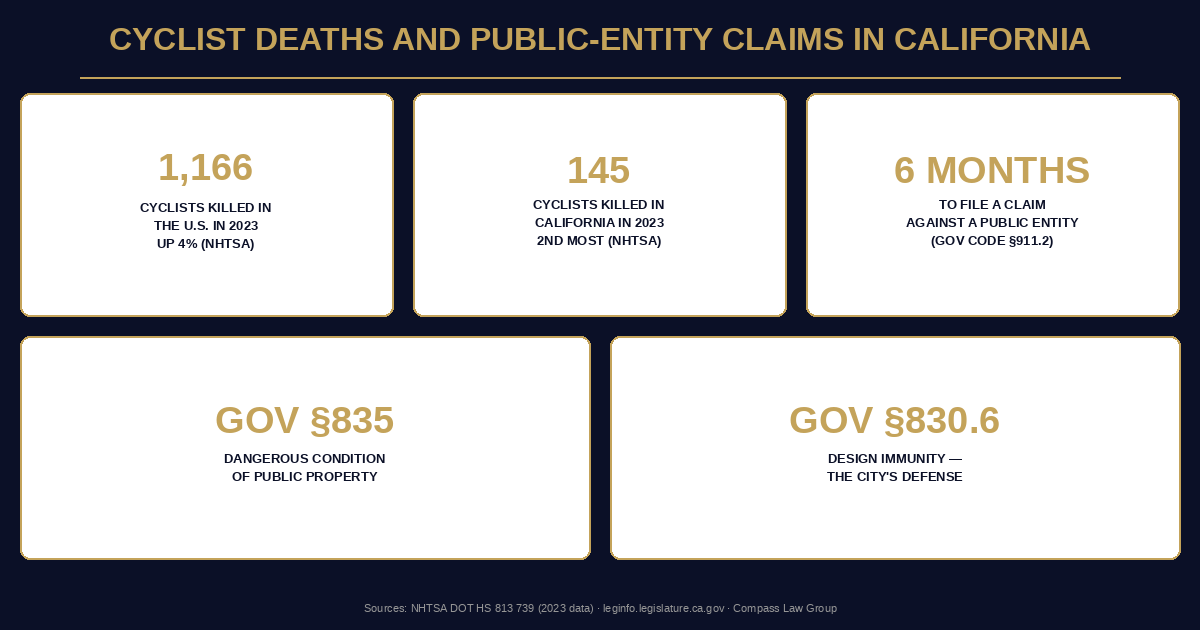
California recorded 145 cyclist deaths in 2023, second only to Florida, out of 1,166 nationwide — a four percent increase over the year before (National Highway Traffic Safety Administration, Bicyclists and Other Cyclists: 2023 Data, DOT HS 813 739). One of California’s 2026 additions to that count was Regan Cole-Graham, 36, killed on Pershing Drive in Playa del Rey while riding with her husband and her 3-year-old son. On August 20, 2026, her widower told KTLA he believes changes to the road killed her.
Key Takeaways
- On January 31, 2026 at about 6 p.m., LAPD says a southbound Toyota Camry struck Regan Cole-Graham’s electric bicycle from behind on Pershing Drive near Manchester Avenue, ejecting her and then rolling over her while pushing the bicycle south with her 3-year-old still in the child saddle.
- Cole-Graham, seven months pregnant, died at the hospital. Her daughter Ophelia was delivered at 31 weeks and died shortly after. The 3-year-old survived. The whole family was wearing helmets.
- The 87-year-old driver stayed at the scene and cooperated, police did not believe alcohol or drugs were involved, and no charges have been filed.
- The family says it will sue the City of Los Angeles, claiming bike lanes were removed from Pershing Drive. A claim like that runs on a six-month clock under Government Code § 911.2 — not two years — and must get past design immunity under § 830.6.
Regan Cole-Graham, 36 and seven months pregnant, was killed on January 31, 2026 when a car struck her e-bike from behind on Pershing Drive in Playa del Rey; her newborn daughter Ophelia also died. Her husband now says removed bike lanes caused the crash, and the family plans a wrongful death claim against the City of Los Angeles.
What happened on Pershing Drive?
CBS Los Angeles, reporting LAPD’s account, described a sequence that is difficult to read. At approximately 6 p.m. on Saturday, January 31, 2026, Cole-Graham was riding a bicycle on Pershing Drive near Manchester Avenue with her 3-year-old in the saddle. A southbound Toyota Camry hit them from behind, ejecting her onto the road. In LAPD’s words, the “Toyota Camry continued south bound, rolling over the bicyclist, while pushing the bicycle south with the child still seated in bicycle saddle.”
Los Angeles Fire Department paramedics took mother and child to the hospital, where Cole-Graham was pronounced dead. Hospital staff delivered the 31-week baby she was carrying. The toddler survived. ABC7 reported that Cole-Graham was a mother of two and a Google executive, and that the driver remained at the scene. The family’s attorney told CBS that everyone in the family was wearing a helmet.

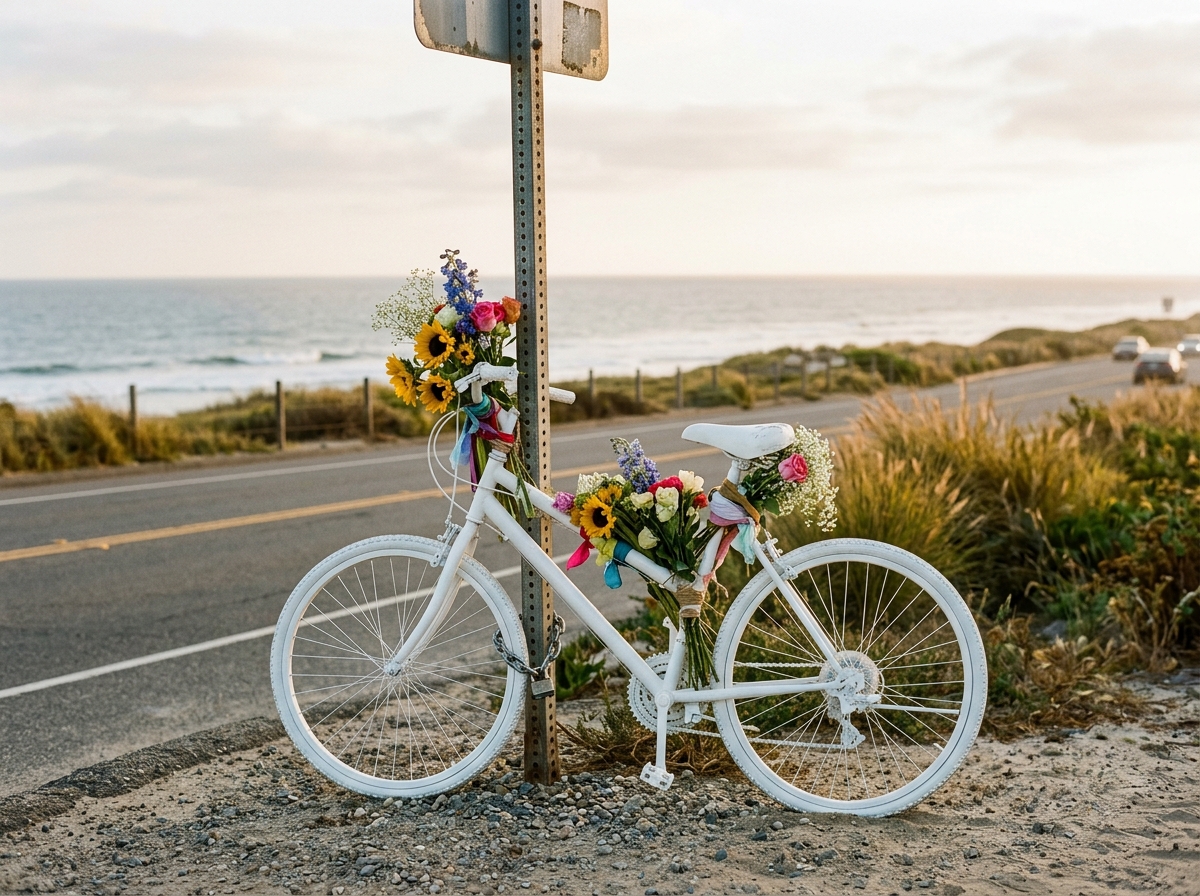
Nearly seven months later, KTLA reported that Matthew Graham had decided to speak publicly, and that the family plans to sue the City of Los Angeles over bike lanes it says were removed from Pershing Drive. “That protection, that area of safety was taken away and we believe that was a critical factor,” the family’s attorney Brian Breiter told the station. Two ghost bikes were placed at the site, and a memorial ride was held in February 2026.
One detail from the reporting is worth flagging honestly: accounts differ on when the baby died. CBS Los Angeles reported that family members said she died the next day; KTLA reported that she was treated in a neonatal intensive care unit and died days later. As explained below, in California that difference is not a trivia point — the legal significance of an infant’s death turns on whether the child was born alive, and for how long.
Why is suing a city different from suing a driver?
Because the clock is a quarter as long and there is an extra step before you ever get to court. Against the driver, the ordinary rule applies: Code of Civil Procedure § 335.1 gives two years for a death or injury claim. Against a public entity, Government Code § 911.2 provides that “a claim relating to a cause of action for death or for injury to person… shall be presented… not later than six months after the accrual of the cause of action.”
That presented claim is an administrative filing made to the entity itself, not a lawsuit. Only after the entity rejects it — or is deemed to have rejected it — does the lawsuit deadline begin to run, and that deadline is its own separate and short period. Families routinely lose viable public-entity cases by waiting the two years they have read about elsewhere.
| Claim against the driver | Claim against the City | |
|---|---|---|
| First deadline | File suit within 2 years (CCP § 335.1) | Present a claim within 6 months (Gov. Code § 911.2) |
| Extra step before suit | None | Administrative claim must be presented and rejected |
| What must be proved | Negligence | Dangerous condition, causation, foreseeability, plus notice or entity-created condition (Gov. Code § 835) |
| Signature defense | Comparative fault | Design immunity (Gov. Code § 830.6) |
| Who may sue for a death | Statutory heirs under CCP § 377.60, plus a survival action by the estate | |
What does a dangerous-condition claim actually require?
Government Code § 835 makes a public entity liable for injury caused by a dangerous condition of its property where the plaintiff establishes that the property was in a dangerous condition at the time of the injury, that the injury was proximately caused by that condition, and that the condition created a reasonably foreseeable risk of the kind of injury that occurred — plus either that an employee’s negligent act within the scope of employment created the condition, or that the entity had notice of it long enough to have protected against it.
Applied to a claim about a removed bike lane, that framework produces a specific list of things that have to be proved rather than argued: what the striping and configuration were before, what they became, who approved the change and when, what the entity knew about collisions, complaints or speeds on that segment afterward, and whether the resulting layout created a foreseeable risk of exactly this kind of rear-end strike on a cyclist. Those facts live in city records, and public records requests are how they are obtained.
What is design immunity, and how is it beaten?
It is the defense that decides most roadway-configuration cases, and it is worth understanding before anyone assumes a claim is easy. Government Code § 830.6 provides that neither a public entity nor a public employee is liable for an injury caused by the plan or design of a construction of, or an improvement to, public property where the plan or design was approved in advance by the legislative body or another body or employee exercising discretionary authority, if a court determines there is any substantial evidence on which a reasonable employee could have adopted, or a reasonable body could have approved, that plan or design.
“Any substantial evidence” is a low bar, and it is decided by the judge, not the jury. But the statute contains its own limit, and it is where these cases are won: the immunity is tied to the approved plan. Where an entity has notice that the improved property is no longer performing as a reasonable body could have approved — changed conditions, an accident history, complaints — the immunity can be lost. Practically, that means the decisive evidence in a case like this is usually not the original approval but everything the city learned afterward.
How does California law treat the death of an unborn or newborn child?
This is the part of the story most likely to be reported loosely, so we will be careful rather than clean. California’s wrongful death statute, Code of Civil Procedure § 377.60, creates a cause of action “for the death of a person.” California courts have long held that a fetus who is never born alive is not a “person” within that statute, so a stillbirth does not support a wrongful death claim — though the mother’s own injuries, including the loss of the pregnancy, remain compensable in her own case.
Where a child is delivered alive and then dies, the analysis is different, and reporting indicates Ophelia was delivered and treated in a neonatal intensive care unit before she died. We are deliberately not stating a conclusion about this family’s claim. Whether a separate action exists for a newborn depends on medical facts — live birth and its documentation — that live in hospital records, not in news coverage, and it is a question for the family’s counsel reviewing those records. It is raised here because families in this situation are frequently told, incorrectly and in both directions, that the answer is obvious.
Source: Compass Law Group | NHTSA, Bicyclists and Other Cyclists: 2023 Data (DOT HS 813 739) + Cal. Gov. Code
How does Compass Law Group help after a cyclist is killed by a driver?
We work the two tracks that a case like this always has, and we start the public-entity track first because it expires first. On the government side that means calendaring the six-month presentation date immediately, then serving public records requests for the striping plans, work orders, traffic studies, council files, complaint logs and collision history for the segment — the material that decides both the § 835 elements and whether design immunity survives.
On the driver side it means preserving the vehicle and its event data, obtaining the traffic collision report, retaining a reconstruction expert while the roadway and sightlines still match the day of the crash, and documenting the lighting at the same hour. Our Los Angeles bicycle accident attorneys handle both, and our wrongful death team handles the heirs’ claims and the estate’s survival action together. We have written about the same evidentiary problems in a Koreatown hit-and-run that killed a cyclist and about the broader trend in surging pedestrian deaths in Los Angeles. Everything is on contingency — no fee unless we recover.
Steps to Take After a Bicycle Crash in Los Angeles
- Treat the six-month government deadline as the real one. If a road, signal, striping or maintenance condition may have contributed, the clock under Gov. Code § 911.2 is six months, not two years.
- Photograph the roadway and the striping immediately, and again at the same time of day. Cities repaint, resurface and reconfigure — sometimes soon after a fatal crash.
- Preserve the bicycle exactly as it is. Do not repair it, strip it or throw it away; on an e-bike, preserve the battery, controller and any ride data.
- Get the traffic collision report number and request the full report when it is released.
- Ask for helmet-cam, dash-cam and neighbor footage within days, in writing, before it is overwritten.
- Keep every medical record for surviving family members, including a child who was on the bike — injuries to a young passenger are their own claim.
- Do not give a recorded statement to any insurer, and do not sign a release, before speaking with your own lawyer.
Our condolences to Matthew Graham and to everyone who loved Regan and Ophelia. Families who go public with a loss this raw usually do it to change a road, and that is worth saying plainly.
This post is based on LAPD statements reported by CBS Los Angeles and ABC7, on KTLA’s August 20, 2026 interview with Matthew Graham, and on the text of the California statutes cited, all retrieved on August 22, 2026. Compass Law Group does not represent the Graham family; the family is represented by other counsel. Nothing here is legal advice about their case.
Frequently Asked Questions
What happened in the Playa del Rey crash?
On the evening of Saturday, January 31, 2026, at about 6 p.m., Regan Cole-Graham, 36, was riding an electric bicycle on Pershing Drive near Manchester Avenue in Playa del Rey with her 3-year-old son in the bicycle saddle. Her husband Matthew Graham was riding alongside. LAPD said a southbound Toyota Camry struck them from behind, ejecting Cole-Graham onto the road, and then rolled over her while pushing the bicycle south with the child still in the saddle. The family were all wearing helmets.
Who died in the crash?
Regan Cole-Graham, 36, a mother of two and a Google executive, was pronounced dead at the hospital. She was seven months pregnant; hospital staff delivered her 31-week daughter, whom the family named Ophelia, and the baby died shortly afterward. Reports differ on exactly when — CBS Los Angeles reported the baby died the next day, while KTLA reported she died days later. The 3-year-old boy survived.
Was the driver charged?
No. LAPD said the driver, an 87-year-old man, remained at the scene and cooperated, and police said they did not believe alcohol or drugs were factors. As of KTLA’s August 20, 2026 report, no charges had been filed against him. A decision not to file criminal charges does not prevent a civil claim, which uses a lower standard of proof.
What is the family’s claim against the City of Los Angeles?
The family has said it plans to file a wrongful death lawsuit against the City of Los Angeles, claiming that bike lanes had been removed from Pershing Drive and that removing that protection endangered cyclists. Their attorney, Brian Breiter, told KTLA that the area of safety “was taken away and we believe that was a critical factor.” A claim of that kind is brought under the dangerous-condition-of-public-property statute, Government Code section 835.
How long do you have to sue a city in California?
Far less time than most people assume. Government Code section 911.2 requires a claim for death or personal injury against a public entity to be presented within six months after the cause of action accrues. Only after that claim is presented and rejected does a lawsuit follow, on its own separate deadline. Missing the six-month presentation deadline can end a case against a public entity before it starts.
What is design immunity, and why does it matter here?
Government Code section 830.6 gives a public entity immunity for an injury caused by the plan or design of a public improvement where the plan or design was approved in advance by a body or employee exercising discretionary authority, and a court finds substantial evidence that a reasonable employee or body could have adopted or approved it. It is the defense a city typically raises when a claim targets a roadway configuration, and defeating it usually turns on notice of changed conditions after approval.
Can a family bring a wrongful death claim for an unborn child in California?
This is a genuinely technical point and it should be reviewed by a lawyer on the specific facts. California’s wrongful death statute, Code of Civil Procedure section 377.60, creates a cause of action for the death of a “person.” California courts have long held that a fetus who is never born alive is not a “person” for that purpose. Where a child is delivered alive and then dies, the analysis is different. Reporting indicates Ophelia was delivered and treated in a neonatal intensive care unit before she died. How that affects any claim is a question for counsel reviewing the medical records, not something to assume from a news report.

If a road you were riding on has been reconfigured, narrowed or restriped and you or someone you love was hit on it, the evidence that proves the point is held by the agency that made the change — and it is obtained by asking for it in writing, early. A free consultation costs nothing and gets the records requests and the six-month calendar moving now. We handle bicycle accident and wrongful death cases across Los Angeles County from our Los Angeles office, and there is no fee unless we recover.
Get Your Free Consultation Today
Hit while cycling in Los Angeles, or lost someone who was? Compass Law Group pursues both the driver and the public entity, and we track the six-month government deadline for you — No Win, No Fee. Call now or request a free, confidential review.
References
- KTLA (via Yahoo News) — Man who lost pregnant wife in Playa del Rey crash speaks out, says dangerous road changes caused her death (August 21, 2026)
- CBS Los Angeles — Pregnant bicyclist dies in Playa del Rey crash while riding with her children and husband (February 3, 2026)
- ABC7 Los Angeles — Pregnant mom of 2 killed after she’s hit by car while riding bike in Playa del Rey (February 4, 2026)
- NHTSA — Traffic Safety Facts, Bicyclists and Other Cyclists: 2023 Data, DOT HS 813 739 (July 2025)
- California Government Code § 835 — dangerous condition of public property
- California Government Code § 911.2 — six-month claim presentation deadline
- California Government Code § 830.6 — design immunity
- California Code of Civil Procedure § 377.60 — wrongful death standing