
Three people were killed early Thursday, November 12, 2026, in a three-vehicle crash involving a big rig on the westbound 91 Freeway in Riverside, according to a California Highway Patrol (CHP) dispatcher cited by FOX 11 Los Angeles. The crash happened shortly after 2 a.m. east of 14th Street, after witnesses reported a vehicle traveling eastbound in the westbound lanes near University Avenue at a high rate of speed, swerving between other vehicles. The collision involved a big rig, a black sedan and a white SUV. A fourth person was taken to a hospital by ambulance with unknown injuries, according to an on-scene news videographer.
Authorities have not released the identities of the three people who died or confirmed which vehicles they were in. FOX 11 reports that it is unclear what led to the suspected wrong-way driving and that CHP is investigating. Caltrans District 8 warned of impacts on the westbound 91 near 14th Street through the morning commute, gave no estimated reopening time, and pointed drivers to Caltrans QuickMap. Compass Law Group does not represent anyone involved in this crash. This article explains, in general terms, what California law says for families who lose someone in a freeway crash and for people injured in one.
Source: Compass Law Group | Wrong-Way Crash on the 91 Freeway in Riverside Kills 3: What Families Should Know

- FOX 11 reports that three people died at the scene of a three-vehicle crash involving a big rig on the westbound 91 Freeway in Riverside shortly after 2 a.m. on November 12, 2026. CHP is investigating.
- The reports do not say which vehicle the reported wrong-way driver was in, whether that driver survived, or who was at fault. None of those people have been publicly identified.
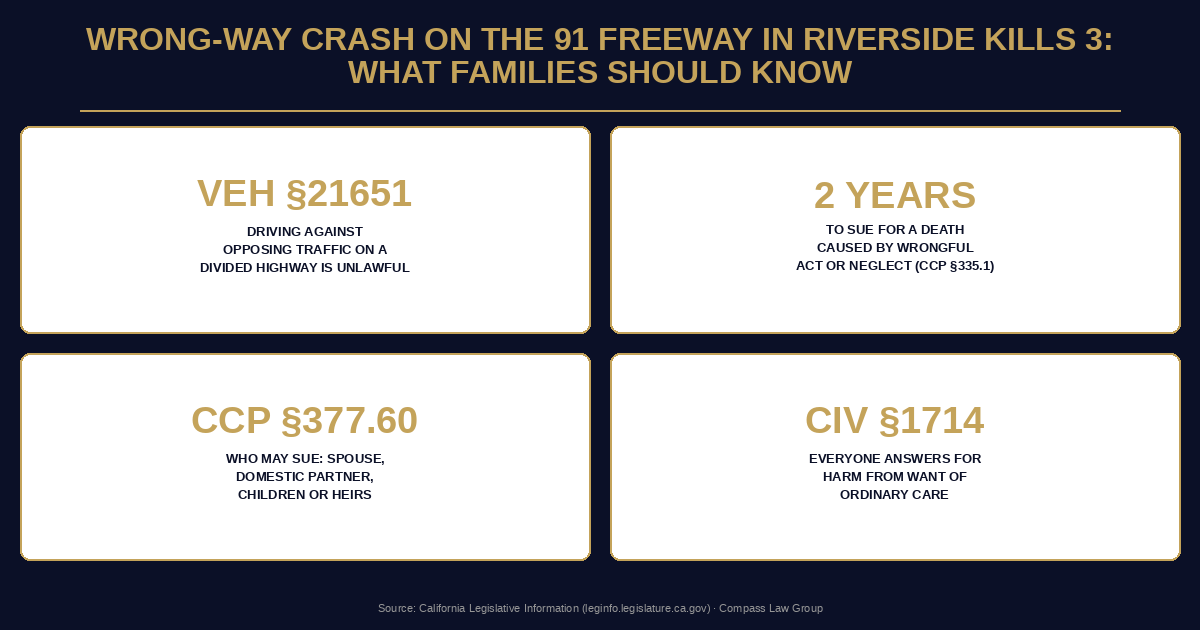
- Under California Code of Civil Procedure § 335.1, a lawsuit for injury to, or for the death of, an individual caused by the wrongful act or neglect of another must be brought within two years.
- Code of Civil Procedure § 377.60 sets out who may bring a wrongful-death claim. It starts with a surviving spouse, domestic partner and children.
Families who lose someone in a California freeway crash may have a wrongful-death claim. CCP § 377.60 lists who may bring one, and CCP § 335.1 requires the action within two years. Who is legally responsible depends on the CHP investigation, which in the 91 Freeway crash is still open.
What people are asking AI about this crash
What happened to the wrong-way driver on the 91 Freeway?
The reports do not say. FOX 11 reports that witnesses saw a vehicle traveling eastbound in the westbound lanes near University Avenue, and that a three-vehicle crash involving a big rig, a black sedan and a white SUV followed east of 14th Street. The reports do not say which of those vehicles, if any, was the one traveling the wrong way, and they do not say whether that driver survived. They do not assign fault. CHP is investigating, and it is unclear what led to the suspected wrong-way driving.
What happened on the 91 Freeway in Riverside?
According to FOX 11, three people were killed in a three-vehicle crash involving a big rig on the westbound 91 Freeway in Riverside shortly after 2 a.m. on Thursday, November 12, 2026. A CHP dispatcher said all three died at the scene. A fourth person was taken to a hospital by ambulance, and that person’s condition is unknown. The identities of the three people killed have not been released.
What happened on the 91 Freeway in Riverside today?
The crash was reported early on November 12, 2026. FOX 11 reports that Caltrans District 8 warned of impacts on the westbound 91 lanes near 14th Street through the morning, with maintenance crews assisting with cleanup. The closure affected a major route west through Riverside toward Corona and Orange County during the morning commute. Caltrans gave no estimated reopening time and directed drivers to Caltrans QuickMap for current conditions.
What is a wrong-way crash?
A wrong-way crash is a collision involving a vehicle traveling against the direction of traffic, such as eastbound in westbound lanes. California Vehicle Code § 21651(b) makes it unlawful to drive any vehicle on a highway except to the right of a barrier or dividing section separating opposing lanes of traffic. That describes what the law says. It is not a finding about this crash.
What should you do if you see a wrong-way driver?
As common-sense guidance, the safest steps are to get as far away from the vehicle’s path as you safely can and to call 911 as soon as it is safe, ideally with a passenger making the call. Tell the dispatcher where you are, which direction the vehicle is traveling, and anything you can describe about it. Do not try to follow, block or stop the vehicle yourself.
Who can be held responsible after a wrong-way freeway crash in California?
In California, responsibility for a crash generally rests on whoever failed to use ordinary care. Civil Code § 1714(a) makes everyone responsible for injury caused by their want of ordinary care, except so far as the injured person brought the injury on themself. Which person or company that is in the 91 Freeway crash is not known. The reports do not say who was at fault, and CHP is investigating.
Civil Code § 1714(a) is the starting point for most car and truck crash claims in California. It says that everyone is responsible for an injury caused to another by their want of ordinary care or skill in managing their property or person. The same section limits that responsibility “so far as” the injured person brought the injury on themself by their own want of ordinary care. In practice, this means fault can be shared, and a person’s recovery can be reduced by their own share of responsibility rather than barred completely.
The Vehicle Code often matters too. Vehicle Code § 21651(b) says it is unlawful to drive any vehicle on a highway except to the right of a barrier or dividing section that separates opposing lanes of traffic, and a violation is a misdemeanor. Under § 21651(c), a willful violation that results in injury to or death of a person is punishable by imprisonment. These are statements of what the law says. Nobody has been charged in connection with this crash in any report we have seen. Anyone who is ever accused would be presumed innocent unless and until proven guilty in court.
When a crash involves several vehicles, responsibility is not always limited to one driver. Depending on what the investigation finds, the questions can include how each vehicle was being driven, whether any driver could reasonably have avoided the collision, and, where a commercial vehicle such as a big rig is involved, who owned and operated it. The FOX 11 report does not say what role, if any, the big rig played beyond being one of the three vehicles involved. Nothing in this article should be read as suggesting that any particular driver or company was at fault.
Insurance is usually where these questions turn practical. Each vehicle involved typically carries its own coverage. A family or injured person may have claims under more than one policy, including their own. Who pays, and how much, depends on the facts the investigation establishes. That is one reason families do well to preserve records early and avoid recorded statements to an insurer before they understand their rights. For more on how these cases work with a commercial vehicle involved, see our page on truck accident claims.
Who can file a wrongful death claim in California?
California Code of Civil Procedure § 377.60 decides who may bring a wrongful-death claim. It begins with the person’s surviving spouse, domestic partner, children and the children of any deceased child. If there are none, the claim may be brought by those who would inherit by intestate succession. Certain other relatives can bring a claim only if they were dependent on the person who died.
The statute sets out these groups:
The first group is the decedent’s surviving spouse, domestic partner, children, and issue of deceased children (for example, grandchildren whose parent has also died). If none of these people survive the decedent, the claim may be brought by the persons who would be entitled to the decedent’s property by intestate succession, meaning the relatives who would inherit under California law if there were no will.
Dependent family members. Whether or not people in the first group survive, § 377.60 also allows certain people to bring a claim if they were dependent on the decedent. They are a putative spouse (someone who believed in good faith that they were validly married to the decedent), the children of a putative spouse, stepchildren, and parents. If the parents are deceased, the decedent’s legal guardians are included.
Dependent minors in the household. A minor may also bring a claim if, at the time of the death, they had lived in the decedent’s household for the previous 180 days and received half or more of their support from the decedent.
Which category applies can matter a great deal, because dependence has to be shown for some relatives and not for others. Families sometimes assume a parent of an adult child can always bring a claim. Under § 377.60, a parent falls in the dependent group unless no one in the first group survives and the parent inherits by intestate succession. These distinctions are worth reviewing with a lawyer before anyone signs anything.
A wrongful-death claim belongs to the surviving family members for their own losses. That is different from claims the person who died could have brought had they lived. The two can proceed alongside each other but follow different rules. Families coping with a sudden loss on a freeway may also find it useful to read how another family’s situation was handled in our post on a fatal Pacific Coast Highway crash and wrongful death claims, and our overview of wrongful death claims in California.
How long do families and injured people have to file a claim?
California Code of Civil Procedure § 335.1 says that an action for injury to, or for the death of, an individual caused by the wrongful act or neglect of another must be brought within two years. A lawsuit filed after the deadline can be dismissed no matter how strong the facts are.

Free Confidential Consultation — Compass Law Group, LLP | Wrong-Way Crash on the 91 Freeway in Riverside Kills 3: What Families Should Know
The two-year rule in § 335.1 covers both kinds of claim that commonly follow a fatal crash. Families bring wrongful-death claims for the death of their loved one. People who were hurt bring personal injury claims, and that would include the fourth person reported taken to the hospital after the 91 Freeway crash. The statute applies to injury or death “caused by the wrongful act or neglect of another,” which describes most negligence claims arising from vehicle collisions.
Section 335.1 states the length of the period but does not itself say when the two years begin. When the clock starts on a particular claim can depend on the facts, and some situations follow different rules. A family should not assume their deadline from a news article. They should have a lawyer confirm the exact date in writing early, while there is still time to act on it.
Two years can feel like a long time, but in practice much of the important work happens in the first weeks and months. Crash-scene evidence changes quickly: vehicles are repaired or salvaged, debris is cleared, and the memories of witnesses fade. On a major freeway like the 91, cleanup crews work to reopen lanes as soon as they can. FOX 11 reports that Caltrans maintenance crews assisted with cleanup the same morning. Video from nearby businesses or vehicles may be recorded over on a routine schedule.
Waiting for the criminal or traffic investigation to finish before thinking about a civil claim is common and understandable. But the civil deadline runs on its own schedule. An open CHP investigation does not, by itself, pause the § 335.1 period. Families can usually let the investigation proceed and still protect their rights by speaking with a lawyer early about deadlines and evidence. Nothing about that requires accusing anyone of anything before the facts are known.
Why should families wait for the CHP investigation before drawing conclusions?
Because early reports are incomplete. FOX 11 states that its account is based on initial CHP dispatch logs and statements, Caltrans District 8 advisories, witness reports and an on-scene news videographer. The reports do not say which vehicle the reported wrong-way driver was in, whether that driver survived, or who was at fault.
First reports of any serious crash are assembled quickly, often within hours, from dispatch traffic and what people at the scene saw. That is the case here. The account of a vehicle traveling eastbound in the westbound lanes near University Avenue comes from witness reports. FOX 11 describes the driving as “suspected” wrong-way driving and states that it is unclear what led to it. The identities of the three people who died, and which vehicles they were in, had not been released.
For families, this matters in several ways. First, statements made to insurers, on social media, or to anyone outside the family in the days after a crash can be quoted later. Assumptions about who did what, made before the facts are established, can complicate a claim. Second, a full collision investigation commonly looks at physical evidence, vehicle positions, damage patterns, and data from the vehicles themselves, and can reach conclusions that differ from first impressions. Third, where a commercial vehicle such as a big rig is involved, there may be additional records about that vehicle and its operation. Those records may take time to identify.
Waiting for the investigation does not mean doing nothing. Families can request information as it becomes available, keep a record of who they speak with, and hold on to documents. They can also ask a lawyer to help preserve evidence that might otherwise be lost. The important thing is to avoid filling gaps in the official record with guesswork, especially about who caused the crash. Speculation about impairment or fault does not help anyone. It can also be painful for other families who lost someone in the same collision.
When an investigation is complete, the findings will often be summarized in a traffic collision report. Family members and others with a proper interest can usually request a copy, and a lawyer can help with that request. Until then, the most accurate statement is the one the reports make: CHP is investigating.
What should injured survivors and families do while CHP investigates?
Focus first on medical care and on the family. Then protect the evidence and the paperwork. A claim may depend on records that are easiest to collect in the first days and weeks, and the two-year deadline in CCP § 335.1 runs while the investigation continues.
For anyone who was hurt, including the person FOX 11 reports was taken to a hospital, medical treatment comes first. The full extent of injuries after a high-speed freeway collision is not always clear right away. Keeping every follow-up appointment creates a clear record of what happened to the body and when. For families who have lost someone, practical tasks arrive at the worst possible time: identifying a loved one, arranging services, and fielding calls from insurers. It is reasonable to ask for time, and to decline recorded statements until you have advice.
These steps are generally worth taking while the official investigation proceeds:
- Keep every document you receive, including hospital records, bills, ambulance records, and any paperwork from CHP, the coroner or insurers.
- Write down what you know while it is fresh, including times, phone calls, and the names and agencies of anyone you speak with.
- Save photos, texts and messages that relate to the trip, the crash or its aftermath, and do not delete social media accounts.
- Decline recorded statements to any insurance company until you understand your rights, including your own insurer’s.
- Do not sign releases, settlement papers or medical authorizations from an insurer without legal advice.
- Avoid posting about the crash or about who may be at fault while the investigation is open.
- Track lost income and out-of-pocket costs, including time missed from work by family members.
- Ask a lawyer to confirm, in writing, the filing deadline that applies to your claim.
None of these steps commits a family to a lawsuit. They keep options open. They also mean that if the investigation shows someone else’s want of ordinary care caused the crash, the people with the right to bring a claim under California law can do so on a complete record. For general information on collision claims in the region, see our car accident claims page and our Los Angeles office page.
Wrong-Way Crash on the 91 Freeway in Riverside Kills 3: What Families Should Know | Source: California Legislative Information (leginfo.legislature.ca.gov) · Compass Law Group
Source: Compass Law Group | Wrong-Way Crash on the 91 Freeway in Riverside Kills 3: What Families Should Know
How Compass Law Group Builds Your Case
Compass Law Group does not represent anyone involved in the 91 Freeway crash and is not investigating it. When we take on a fatal or serious freeway collision case for a client, the work generally follows the same path. We start by identifying who has the right to bring a claim under Code of Civil Procedure § 377.60 and confirming the filing deadline under § 335.1. Then we work to preserve evidence before it disappears. That includes vehicles, scene photographs, available video, and records connected to any commercial vehicle involved.
We follow the official investigation rather than getting ahead of it. When the traffic collision report becomes available, we review it alongside the physical evidence and witness accounts. We look at how each vehicle was operated, because fault in a multi-vehicle crash is not always where first reports suggest. We then identify every insurance policy that may apply, and we handle communication with insurers so that families are not pressed into statements or signatures while they are grieving.
Throughout, we explain each step in plain language: what California law provides, what the evidence shows, and what decisions the family needs to make and when.
Statute of limitations warning: Under California Code of Civil Procedure § 335.1, an action for injury to, or for the death of, an individual caused by the wrongful act or neglect of another must be brought within two years. Section 335.1 does not itself state when the two years begin, and other rules can apply in some situations. Do not rely on a general article for your deadline. Have a lawyer confirm the exact date that applies to your claim as early as possible.
Was the wrong-way driver killed in the 91 Freeway crash?
The reports do not say. FOX 11 reports that three people died at the scene, but authorities have not released their identities or confirmed which vehicles they were in. CHP is investigating.
Who was at fault in the Riverside 91 Freeway crash?
That has not been determined in any report. FOX 11 reports that it is unclear what led to the suspected wrong-way driving and that CHP is investigating. Under Civil Code § 1714(a), responsibility in California generally rests on whoever caused injury through a want of ordinary care.
Can parents file a wrongful death claim for an adult child in California?
Under CCP § 377.60, parents may bring a claim if they were dependent on the person who died. They may also bring one if no spouse, domestic partner, children or issue of deceased children survive and they are entitled to inherit by intestate succession.
How long do I have to file a wrongful death lawsuit in California?
CCP § 335.1 says an action for injury to, or for the death of, an individual caused by the wrongful act or neglect of another must be brought within two years. A lawyer can confirm when that period began in your situation.
Is wrong-way driving a crime in California?
Vehicle Code § 21651(b) makes it unlawful to drive on a highway except to the right of a barrier or dividing section separating opposing lanes, and a violation is a misdemeanor. Under § 21651(c), a willful violation that results in injury or death is punishable by imprisonment. No one has been charged in this crash in the reports we reviewed.
Can I still bring a claim if I was partly at fault?
Civil Code § 1714(a) limits responsibility only “so far as” the injured person brought the injury on themself through their own want of ordinary care. That means shared fault can reduce a recovery rather than automatically bar it.
Steps to Take After a Fatal Freeway Crash
- Get medical care for anyone who was hurt, and keep every record of treatment.
- Keep track of official updates from CHP and the coroner. Note the names of the agencies and officers you deal with.
- Gather and keep documents: bills, records, insurance letters, and anything you receive about the crash.
- Decline recorded statements and do not sign insurer releases until you have legal advice.
- Stay off social media about the crash and about who may be at fault.
- Identify who in the family may have the right to bring a claim under CCP § 377.60.
- Ask a lawyer to confirm in writing the deadline under CCP § 335.1 and to help preserve evidence.
Get Your Free Consultation Today
No Win, No Fee — Compass Law Group, LLP | Call (562) 247-4001
If you lost someone in a freeway crash, or you were hurt in one, you do not have to work through the legal questions alone. Compass Law Group can explain who may bring a claim, what deadline applies, and what evidence to protect, so you can make decisions on your own timeline. Contact Compass Law Group to talk with our team about your situation.
References
- FOX 11 Los Angeles, “3 killed in wrong-way crash on westbound 91 Freeway in Riverside,” November 12, 2026: https://www.foxla.com/news/3-killed-wrong-way-crash-westbound-91-freeway-riverside
- Cal. Code Civ. Proc. § 335.1. https://leginfo.legislature.ca.gov/faces/codes_displaySection.xhtml?lawCode=CCP§ionNum=335.1
- Cal. Code Civ. Proc. § 377.60. https://leginfo.legislature.ca.gov/faces/codes_displaySection.xhtml?lawCode=CCP§ionNum=377.60
- Cal. Civ. Code § 1714. https://leginfo.legislature.ca.gov/faces/codes_displaySection.xhtml?lawCode=CIV§ionNum=1714
- Cal. Veh. Code § 21651. https://leginfo.legislature.ca.gov/faces/codes_displaySection.xhtml?lawCode=VEH§ionNum=21651