



$14.5M
Settlement
Truck Accident
$13M
Settlement
Trial Verdict
$9.87M
Settlement
Bike Accident
$2.25M
Settlement
Ride Share Accident
$2.25M
Settlement
Slip and Fall
California Pedestrian Accident Lawyers Who Know Every Version of the Right-of-Way Rule
California is consistently among the deadliest states in the country for pedestrians. The Governors Highway Safety Association reports that California sees more than 1,000 pedestrian fatalities a year — roughly one in six pedestrian deaths nationwide. The California Highway Patrol SWITRS database shows that the largest share of those deaths happen on arterial roadways in Los Angeles County, the Bay Area, and the Central Valley corridors — not on freeways, and usually at or near marked crosswalks and intersections.
Compass Law Group, LLP handles California pedestrian cases from seven offices — Beverly Hills, Los Angeles, Long Beach, San Francisco, Sacramento, Oakland, and Bell Gardens. Our firm has recovered more than $250,000,000 total for California injury victims.
Do I have a case?
Free Consultation
California Vehicle Code § 21950 — The Pedestrian Right-of-Way Rule
Vehicle Code § 21950 is the foundation of every California pedestrian case. The statute requires that “the driver of a vehicle shall yield the right-of-way to a pedestrian crossing the roadway within any marked crosswalk or within any unmarked crosswalk at an intersection.” That word unmarked is critical: California recognizes unmarked crosswalks at every intersection by default. You do not need painted lines to have crosswalk rights at a typical four-way intersection.
Section 21950(b) balances the rule: “This section does not relieve a pedestrian from the duty of using due care for his or her safety. No pedestrian may suddenly leave a curb or other place of safety and walk or run into the path of a vehicle that is so close as to constitute an immediate hazard. No pedestrian may unnecessarily stop or delay traffic while in a marked or unmarked crosswalk.” That second half is the defense’s playbook — “your client stepped out suddenly” — and we beat it with the specific physical evidence of each case: video, skid marks, sight-line analysis, and independent witnesses.

Who Is Liable in a California Pedestrian Case
Pedestrian cases are more often about vehicle insurance than about the driver personally:
The at-fault driver’s bodily injury policy
California requires only $15,000/$30,000 minimum, which rarely covers a pedestrian injury
An employer’s commercial auto policy
when the driver was on the clock
A government entity
when a defective roadway, broken signal, or missing signage contributed; strict 6-month government claim deadline
The pedestrian’s own auto UM/UIM coverage
yes, your own auto policy’s UM/UIM coverage usually follows you onto the sidewalk
A rideshare platform’s $1M policy
see our Uber accident attorneys when the driver was on an active Uber or Lyft trip
A commercial truck or bus defendant
see our truck and bus practice areas
Common California Pedestrian Injuries
Pedestrian injuries are severe by definition because pedestrians have no crumple zones, airbags, or seatbelts. We see the same cluster of catastrophic injuries in nearly every case: traumatic brain injury from the initial impact and secondary impact with the ground, spinal cord injury, multiple long-bone and pelvic fractures, internal organ damage, severe road rash, amputation, and in the worst cases wrongful death. When the at-fault driver was impaired, our drunk driving accident attorneys layer on punitive damages. When the pedestrian was on a bicycle, the case follows the rules of our bicycle accident practice. Pedestrian cases where the vehicle involved was a passenger car follow our car accident framework; when the vehicle was a commercial rig or rideshare, the relevant rules change.

How We Value a California Pedestrian Accident Case
Clear liability
marked crosswalk, walk signal, signed police report, independent witnesses, video
Permanent impairment
ongoing pain, loss of range of motion, inability to return to work, disfigurement
Catastrophic injury
TBI, SCI, amputation, multiple fractures requiring surgery
Multiple layers of coverage
commercial, rideshare, umbrella, stacked UM/UIM
Egregious driver conduct
DUI, phone use, hours-of-service violations, fleeing the scene
We only take pedestrian cases we are prepared to try. Pedestrian cases with clear Vehicle Code § 21950 violations and catastrophic injuries can support seven and eight-figure recoveries. Past results do not guarantee future outcomes. Every case is unique.
California Deadlines You Cannot Miss
California gives injured pedestrians two years from the crash date to file a personal injury lawsuit under CCP § 335.1. Wrongful death claims follow the same two-year rule under CCP § 377.60. If a government-owned vehicle was involved — a CHP cruiser, a city garbage truck, a public transit bus, a school bus — you have only six months to file a written government claim under California Government Code § 911.2 before you can sue. Government claims also apply when a defective roadway, broken signal, missing signage, or obstructed sight line contributed.
California Intersections Where Pedestrian Crashes Concentrate
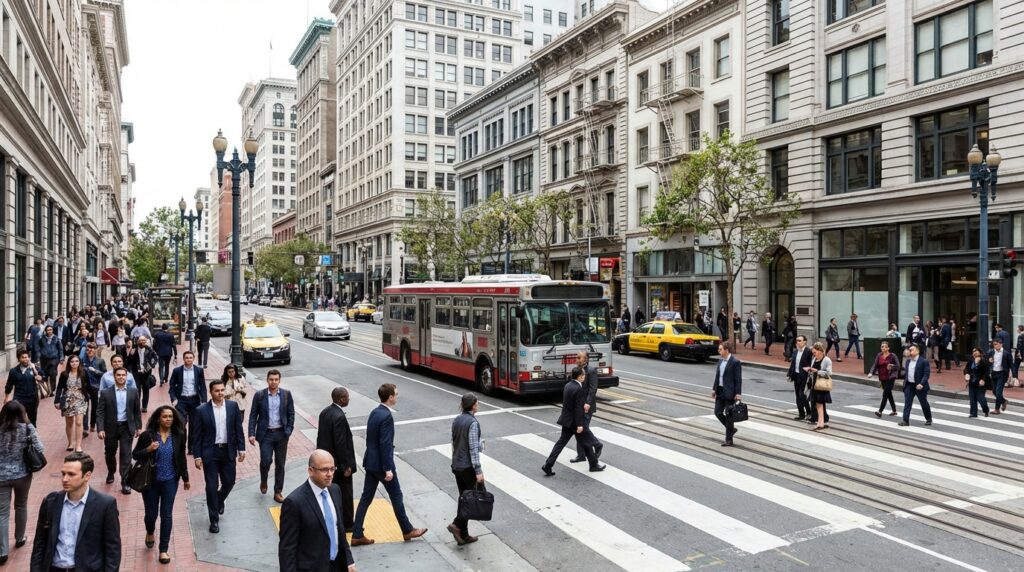
Pedestrian crashes happen on the same arterials and intersections year after year. In LA County, the Los Angeles corridors of Vermont, Western, Figueroa, and Sunset Boulevard produce the highest pedestrian-fatality counts in the state. In Beverly Hills, Wilshire at Crescent and Canon are chronic hot spots. In Long Beach, Pacific Coast Highway, Anaheim Street, and Atlantic Avenue see the bulk of serious injury walks. In Bell Gardens, Eastern Avenue and Florence Avenue arterials concentrate the highest counts. In San Francisco, Market Street, Van Ness, 19th Avenue, and the Tenderloin grid produce high-volume pedestrian injury cases. In Oakland, International Boulevard and MacArthur Boulevard are long-standing hot spots. In Sacramento, Broadway, Stockton Boulevard, and the downtown K Street corridor generate the bulk of injury cases.
First 48 Hours After a California Pedestrian Crash
Get trauma-level medical care — pedestrian impacts produce injuries that often look less serious than they are in the first hour. Keep every bill, every imaging report, every discharge instruction. Photograph the intersection, the crosswalk paint, the walk signal, skid marks, the vehicle, and your visible injuries. Obtain the police report number and officer name. Do not give a recorded statement to any insurance adjuster — yours or theirs. Do not post on social media. Do not sign anything from the driver’s carrier. Call a California pedestrian accident attorney who can open UM/UIM claims, send preservation letters, and begin the evidence work.
Meet the Attorneys Leading Your Case
Your case at Compass Law Group is led by one of our two managing partners. Together they bring decades of California personal injury trial experience, hundreds of millions of dollars in verdicts and settlements, and a courtroom record that forces defense carriers to take the case seriously from day one.
Joseph Shirazi
Managing Partner, CA Bar #265403. A Loyola Law School graduate named to the National Top 100 Trial Lawyers and holder of an Avvo 10.0 “Superb” rating. His results include a $14,500,000 truck accident verdict and a $13,000,000 trial verdict. He is a member of Consumer Attorneys of California, Consumer Attorneys Association of Los Angeles (CAALA), and the American Association for Justice. Read Joseph Shirazi’s full bio →
Simon Esfandi
Managing Partner, CA Bar #275307. A Southwestern Law School graduate recognized as a Super Lawyers Rising Star. He led the firm’s $9,870,000 motorcycle accident settlement and a $2,250,000 rideshare recovery, and focuses his practice on catastrophic personal injury trials. Read Simon Esfandi’s full bio →
Both partners are admitted to practice in every California state trial court and in the United States District Court for the Central District of California. Compass Law Group was founded in 2015, maintains a 5.0/5.0 rating on Google across 193+ verified client reviews, and has recovered more than $250,000,000 for injury victims across the state. Past results do not guarantee future outcomes. Every case is unique.
Why Compass Law Group
- $250,000,000+ recovered for California injury and wrongful death victims
- Seven and eight-figure results on fatal truck accident and motorcycle accident cases — past results do not guarantee future outcomes
- 5.0 stars on Google, 193+ verified client reviews
- Seven California offices — Beverly Hills, Los Angeles, Long Beach, San Francisco, Sacramento, Oakland, Bell Gardens
- No win, no fee — we advance every cost and only get paid when you do
- Free confidential consultations in English, Spanish, Farsi, and Korean — available 24/7 at (213) 699-5475
Take the first step
towards recovery
- Call us at (310) 598-7469 for a FREE, no-obligation consultation. We’re available 24/7 to answer car accident victims’ questions and discuss your case.
- Fill out our online contact form. We’ll get back to you promptly to schedule a time to talk.
- Visit our office in Beverly Hills. We’re conveniently located and ready to welcome you.
Frequently Asked Questions
What is the average settlement for a pedestrian hit by a car?
There is no average. Pedestrian cases range from five figures for minor soft-tissue claims to eight figures for catastrophic or fatal injuries. Most serious pedestrian cases fall in the six to seven-figure range depending on the severity and available coverage. Past results do not guarantee future outcomes. Every case is unique.
What should I do if I’m hit by a car as a pedestrian?
Call 911, accept ambulance transport to a trauma center, photograph the scene and vehicle, collect witness contact information, obtain the police report number, preserve your clothing and shoes, and call a pedestrian accident attorney before giving any recorded statement to an insurance adjuster.
Can a pedestrian be at fault for an accident in California?
Yes. California is a pure comparative-fault state. A pedestrian who stepped into traffic against a signal, stepped off a curb suddenly in front of an oncoming car, or was distracted by a phone can be assigned a percentage of fault. The case is reduced by that percentage but not eliminated.
Do drivers always have to yield to pedestrians?
Under Vehicle Code § 21950, yes — drivers must yield to pedestrians in any marked or unmarked crosswalk. Pedestrians also have a duty of reasonable care and cannot step into traffic so close that stopping is impossible.
How long do I have to file a pedestrian accident claim?
Two years from the crash date under CCP § 335.1. Six months for a written government claim under Government Code § 911.2 if a government vehicle or roadway was involved.
What damages can I recover as a pedestrian accident victim?
Medical bills (past and future), wage loss and loss of earning capacity, pain and suffering, loss of enjoyment of life, home modifications, and — if the driver’s conduct was egregious — punitive damages. Catastrophic cases also include life-care plans and long-term rehabilitation costs.