



$14.5M
Settlement
Truck Accident
$13M
Settlement
Trial Verdict
$9.87M
Settlement
Bike Accident
$2.25M
Settlement
Ride Share Accident
$2.25M
Settlement
Slip and Fall
California Truck Accident Lawyers Who Know What’s on the Line
A collision with a fully loaded 18-wheeler is not a bigger car crash. A commercial truck weighs up to 80,000 pounds — roughly twenty times heavier than the average passenger vehicle — and at highway speed that mass translates into injuries that reshape the rest of a person’s life. The National Highway Traffic Safety Administration counted 5,936 people killed and an estimated 160,608 injured in crashes involving large trucks in the most recent reporting year, and occupants of the smaller vehicle account for the overwhelming majority of those deaths.
Compass Law Group, LLP handles California truck accident cases from seven offices — Beverly Hills, Los Angeles, Long Beach, San Francisco, Sacramento, Oakland, and Bell Gardens. We have tried cases involving tractor-trailers, delivery box trucks, tanker rigs, garbage trucks, cement mixers, and Amazon-branded last-mile vehicles. Our managing partner Joseph Shirazi, CA Bar #265403, has been recognized among the National Top 100 Trial Lawyers, and our firm has recovered $250,000,000+ for injury victims across California.
Do I have a case?
Free Consultation
The Federal Rulebook That Car Crash Cases Don’t Touch
The single biggest difference between a passenger-car crash and a commercial truck crash is the Federal Motor Carrier Safety Regulations (49 CFR Parts 350-399). These rules govern hours of service, driver qualification, drug and alcohol testing, vehicle maintenance, cargo securement, and electronic logging. When a motor carrier or driver violates one of these rules and that violation contributes to a crash, California juries treat it as powerful evidence of negligence per se.
The pieces of evidence that win truck cases rarely survive long after the crash. Electronic Control Module data, ELD hours-of-service records, dashcam footage, dispatch logs, maintenance files, drug-test results, and driver qualification files can all be overwritten, deleted, or “lost” within 30 to 180 days unless a spoliation letter locks them down. The first call we make in any new truck case is to preserve that evidence before it disappears.
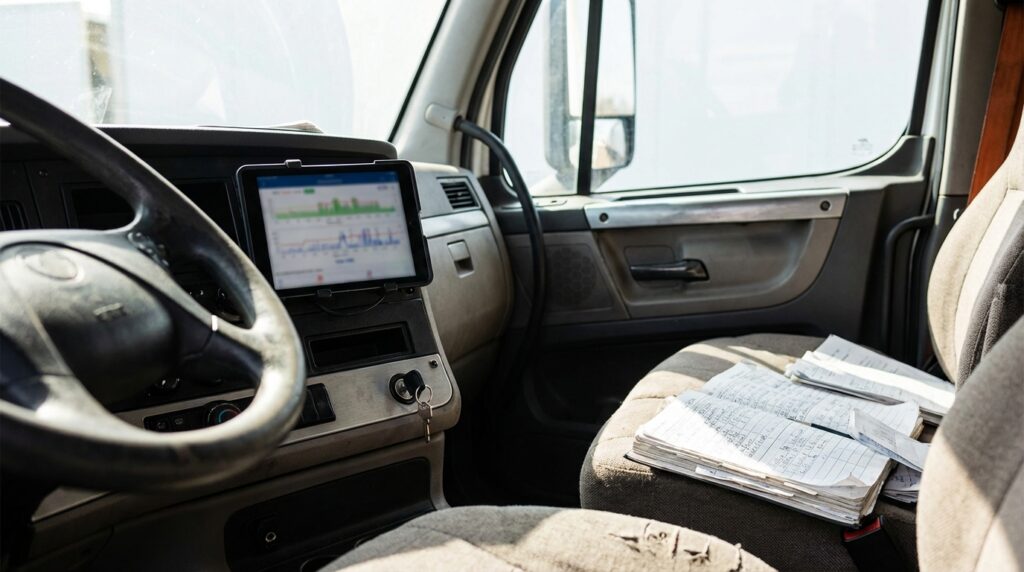
Who Is Actually on the Hook After a Truck Crash
One of the hardest lessons families learn after a truck crash is that “the trucker hit me” is never the whole story. Commercial trucking operates through layered contracts between drivers, motor carriers, brokers, shippers, maintenance vendors, and cargo loaders.
Any one of them — sometimes several of them at once — can share fault:
The driver
The driver, for fatigue, impairment, speeding, distraction, or violating hours-of-service rules
The motor carrier
The motor carrier, for negligent hiring, failure to train, failure to supervise, or pressuring drivers to beat the clock
The truck owner or lessor
The truck owner or lessor, under California’s common-carrier and vicarious-liability doctrines
The maintenance contractor
The maintenance contractor, for brake failures, blown tires, or defective inspections
The cargo shipper or loader
The cargo shipper or loader, for overweight, unbalanced, or unsecured loads
A parts manufacturer
A parts manufacturer, for a defective brake, coupling, tire, or underride guard
Identifying every responsible party isn’t academic — it’s the difference between a settlement capped by one insurance policy and a recovery that reaches all the layers of coverage that exist on a commercial vehicle. Commercial trucks operating across state lines carry minimum liability of $750,000 to $5,000,000, and many fleets carry excess policies on top of that. A car crash case might fight over $30,000. A truck case often fights over millions.
Common Injuries We See in California Truck Cases
Because of the disparity in size and force, truck crashes produce a predictable cluster of catastrophic injuries: traumatic brain injury, spinal cord injury and paralysis, multiple orthopedic fractures, internal organ damage, amputation, severe burns from cargo fires, and wrongful death. These injuries produce medical bills that run into seven figures over a lifetime. Our firm builds every truck case assuming the client will need a life-care plan, a vocational expert, and an economist to translate future medical needs into present-value damages.
If you lost a loved one, we also handle wrongful death claims under California Code of Civil Procedure § 377.60, which gives surviving spouses, children, and dependents the right to recover for loss of financial support, loss of companionship, and funeral costs. If the driver was impaired, our drunk driving accident attorneys can pursue punitive damages on top of compensatory damages. When a truck strikes a passenger car the legal and medical picture is very different from an ordinary car accident case, and when the victim was on two wheels the injuries parallel what we see in motorcycle accident claims. Pedestrians hit by trucks and delivery vehicles have their own set of rules under California’s vehicle code — our pedestrian accident and bicycle accident teams work these cases regularly.
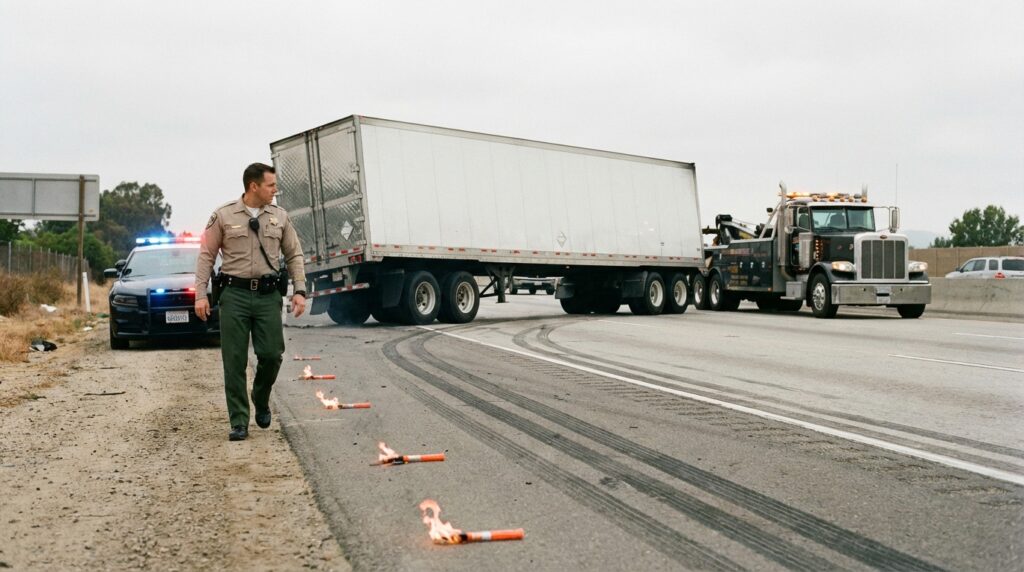

How We Value a California Truck Accident Case
No honest attorney will quote you a number at the first call. Truck accident case value depends on liability clarity, the severity and permanence of injuries, total economic losses, the defendant’s conduct (reckless behavior opens the door to punitive damages), available insurance coverage, and the venue of suit. What we can tell you is what factors push a case toward the top of its range:
Clear liability:
- ELD data or dashcam showing an hours-of-service violation, a failed drug test, or phone-use distraction
High wage-loss:
- Working-age victims with provable pre-crash earnings
Permanent injury:
- Documented TBI, spinal cord injury, amputation, or disfigurement
Egregious carrier conduct:
- Prior safety violations, ignored maintenance complaints, known driver problems
Multiple layers of coverage:
- Excess policies, umbrella policies, MCS-90 endorsements
California Deadlines You Cannot Miss
California gives injured people two years from the date of a truck crash to file a personal injury lawsuit under CCP § 335.1. Wrongful death claims follow the same two-year rule from the date of death under CCP § 377.60. If a government-owned truck is involved — a city garbage truck, a state-owned vehicle, or a transit bus — you have only six months to file a written government claim under the California Government Claims Act (Government Code § 911.2) before you can even file suit. Miss either deadline and your claim is gone regardless of how strong it was.
California Roads Where Truck Crashes Keep Happening
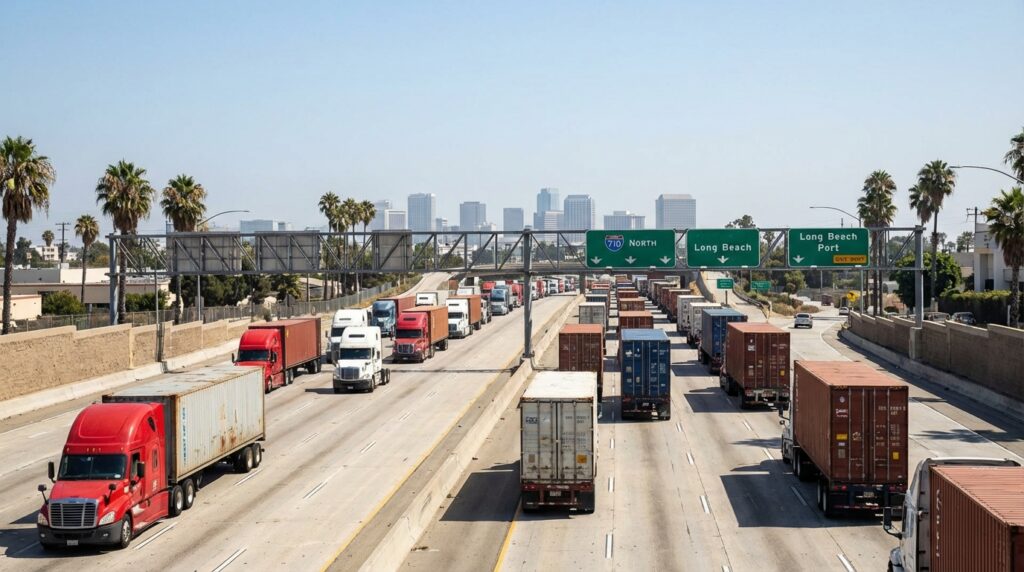
Truck crashes are not randomly distributed across California. We see the same corridors again and again, and our local teams know each one in detail. The I-5 freight spine runs from the Grapevine through the Central Valley and up into Sacramento, where the I-80 Yolo causeway adds a second high-volume freight route. The I-710 Long Beach port corridor funnels cargo containers out of the Ports of LA and Long Beach and straight through Bell Gardens on the way to the inland warehouse belt.
Downtown Los Angeles and Beverly Hills sit at the junction of the I-10, US-101, and I-405 — the densest big-rig corridor in Southern California. In the Bay Area, the I-880 Nimitz freeway ties the Port of Oakland to Hayward and Fremont, while the I-80 Bay Bridge and US-101 feed commercial traffic into downtown San Francisco and the I-580 Altamont grade handles the high-wind long-haul route between Livermore and Stockton. Night-time hours, construction zones, and downgrade sections on any of these routes produce the highest concentration of catastrophic truck crashes in the state.
What to Do in the First 72 Hours After a Truck Crash
The decisions made in the first three days after a truck crash shape the rest of the case. Get full medical care, keep every bill and record, photograph vehicle damage and the scene, obtain the CHP or police report number, write down names and insurance information for every witness and every driver involved, and do not give a recorded statement to any insurance adjuster — yours or theirs — before speaking with an attorney. Do not accept a quick “courtesy” settlement offer while you are still in treatment. Call a truck accident lawyer who can send a spoliation letter within days of the crash so that the motor carrier cannot destroy ECM data, ELD records, dashcam footage, or driver qualification files while your case is still in its infancy.
Meet the Attorneys Leading Your Case
Your case at Compass Law Group is led by one of our two managing partners. Together they bring decades of California personal injury trial experience, hundreds of millions of dollars in verdicts and settlements, and a courtroom record that forces defense carriers to take the case seriously from day one.
Joseph Shirazi
Managing Partner, CA Bar #265403. A Loyola Law School graduate named to the National Top 100 Trial Lawyers and holder of an Avvo 10.0 “Superb” rating. His results include a $14,500,000 truck accident verdict and a $13,000,000 trial verdict. He is a member of Consumer Attorneys of California, Consumer Attorneys Association of Los Angeles (CAALA), and the American Association for Justice. Read Joseph Shirazi’s full bio →
Simon Esfandi
Managing Partner, CA Bar #275307. A Southwestern Law School graduate recognized as a Super Lawyers Rising Star. He led the firm’s $9,870,000 motorcycle accident settlement and a $2,250,000 rideshare recovery, and focuses his practice on catastrophic personal injury trials. Read Simon Esfandi’s full bio →
Both partners are admitted to practice in every California state trial court and in the United States District Court for the Central District of California. Compass Law Group was founded in 2015, maintains a 5.0/5.0 rating on Google across 193+ verified client reviews, and has recovered more than $250,000,000 for injury victims across the state. Past results do not guarantee future outcomes. Every case is unique.
Why Compass Law Group
- $250,000,000+ recovered for California injury and wrongful death victims
- Seven and eight-figure results on fatal truck accident and motorcycle accident cases — past results do not guarantee future outcomes
- 5.0 stars on Google, 193+ verified client reviews
- Seven California offices — Beverly Hills, Los Angeles, Long Beach, San Francisco, Sacramento, Oakland, Bell Gardens
- No win, no fee — we advance every cost and only get paid when you do
- Free confidential consultations in English, Spanish, Farsi, and Korean — available 24/7 at (213) 699-5475
Take the first step
towards recovery
- Call us at (310) 598-7469 for a FREE, no-obligation consultation. We’re available 24/7 to answer car accident victims’ questions and discuss your case.
- Fill out our online contact form. We’ll get back to you promptly to schedule a time to talk.
- Visit our office in Beverly Hills. We’re conveniently located and ready to welcome you.
Frequently Asked Questions
What is the average truck accident settlement in California?
There is no single “average” — California truck accident case values range from tens of thousands for minor soft-tissue injuries to eight figures for catastrophic injury and wrongful death. What drives a case to the top of its range is clear liability, permanent injury, strong economic losses, and carrier conduct that a jury will find reckless. Compass Law Group has recovered $14,500,000 on a single truck accident verdict. Past results do not guarantee future outcomes. Every case is unique.
Who is liable — the driver or the trucking company?
Both are usually on the hook, and often additional parties too. Under California’s vicarious liability rules, a motor carrier is legally responsible for the negligence of drivers acting within the scope of employment. On top of that, carriers can be directly liable for negligent hiring, training, or supervision. Brokers, shippers, maintenance vendors, and parts manufacturers can also share fault depending on what caused the crash.
How is a truck accident case different from a car accident case?
Truck cases are governed by the Federal Motor Carrier Safety Regulations, carry much larger insurance policies (often $1–$5 million or more), involve more defendants, rely on short-fuse electronic evidence like ELD and ECM data, and almost always require accident reconstruction and trucking-industry experts. The investigation starts on day one with a spoliation letter locking down evidence before it’s destroyed.
What federal regulations apply to commercial trucks?
The Federal Motor Carrier Safety Regulations (49 CFR Parts 350-399) control driver hours of service, driver qualification, drug and alcohol testing, vehicle maintenance and inspection, cargo securement, and crash reporting. Violations routinely become the backbone of a California truck accident lawsuit.
How long do I have to file a truck accident claim in California?
Two years from the date of the crash for a personal injury claim under CCP § 335.1. Two years from the date of death for a wrongful death claim under CCP § 377.60. If a government vehicle is involved, you have only six months to file a government claim under Government Code § 911.2 before you can sue.
What evidence is important in a truck accident case?
ECM and Electronic Logging Device data, driver qualification files, drug and alcohol test results, hours-of-service logs, maintenance and inspection records, dashcam and onboard camera footage, dispatch and routing records, weigh-station records, post-crash drug tests, and all prior DOT safety violations. Most of this evidence has a short shelf life and must be preserved with a formal spoliation letter.