






On Tuesday, September 15, 2026, a sport utility vehicle collided with a Los Angeles Metro bus near Nordhoff Street and De Soto Avenue in Chatsworth, in the San Fernando Valley (NBC Los Angeles, Sept. 16, 2026). The Los Angeles Fire Department said the crash happened at 5:03 p.m. (NBC News, Sept. 16, 2026). At least two people were killed and six were injured; the LAPD described the two who died as bus passengers (NBC Los Angeles, Sept. 16, 2026). Both men who died were passengers on the bus, according to an LAPD statement (San Bernardino Sun, Sept. 16, 2026). Our thoughts are with everyone who was hurt and with the families who lost someone.
According to LA Metro, the Line 166 bus was eastbound on Nordhoff Street when it was hit. Police said the SUV was traveling south in the northbound lanes of De Soto Avenue, ran a red light, nearly struck another vehicle, then collided with the bus and ended up partially inside it; one bus passenger was ejected (NBC Los Angeles, Sept. 16, 2026). Police said the force of the collision ejected one passenger and partially ejected a second, and fire officials said two of the six people taken to hospitals had to be freed from the wreckage — one from the bus and one from the SUV (San Bernardino Sun, Sept. 16, 2026). Firefighter-paramedics worked to free people trapped in the wreckage, some with crushing injuries. Authorities said one passenger was severely injured and the other passengers’ injuries were not life-threatening (NBC Los Angeles, Sept. 16, 2026).
Source: Compass Law Group | Chatsworth Metro Bus Crash: Rights of Injured Bus Passengers and Families in Los Angeles

The SUV driver was arrested on suspicion of murder. Police said the driver is suspected of reckless driving and running a red light, combined with possible DUI, and the case will be forwarded to county prosecutors to consider charges (NBC Los Angeles, Sept. 16, 2026). No charges had been reported at the time of that report. An arrest is not a conviction, and the driver is presumed innocent unless and until proven guilty in court.
Shortly before 7 p.m. that same evening, a news helicopter covering the bus crash went down in a parking lot near a self-storage facility in Chatsworth. Three people were killed — the two crew members aboard and one person on the ground — and two other people were taken to the hospital (NBC News, Sept. 16, 2026). The National Transportation Safety Board is leading that investigation with the Federal Aviation Administration involved, and the cause had not been determined (NBC News, Sept. 16, 2026). Los Angeles Mayor Karen Bass said, “We lost five Angelenos today” (NBC News, Sept. 16, 2026).
Compass Law Group does not represent anyone involved in these incidents. This article explains, in general terms, the rights California law gives injured bus passengers and the families of people killed in transit crashes, so that anyone facing a similar situation knows what deadlines and options exist.
Video: “2 dead, 6 hospitalized after SUV crashes into Metro bus in Chatsworth” — NBCLA on YouTube, published September 15, 2026. Watch on YouTube. Video credit: NBCLA. Compass Law Group is not affiliated with NBCLA.
Video: “Helicopter providing coverage for NBC L.A. crashes, killed 3 | NBCDFW” — NBC DFW on YouTube, published September 16, 2026. Watch on YouTube. Video credit: NBC DFW. Compass Law Group is not affiliated with NBC DFW.
Key Takeaways
- Injured bus passengers in California may have claims against more than one party, including an at-fault driver and, where the facts support it, the transit agency that operates the bus.
- A claim against a public transit agency such as LA Metro generally must be presented in writing no later than six months after the claim accrues — usually the date of the injury or death — under the Government Claims Act, far sooner than the usual two-year deadline to sue a private party.
- A criminal case and a civil injury case are separate; a family does not need to wait for prosecutors or a verdict before protecting its civil rights.
- A surviving spouse, domestic partner, children or other heirs may bring a wrongful death claim, and the person’s personal representative may bring a separate survival claim.
Passengers injured in a Los Angeles bus crash, and families of passengers who were killed, can usually seek compensation from the driver whose conduct caused the collision and, when the evidence supports it, from the bus operator. A written claim against a public agency like LA Metro is generally due within six months.
Who Can Be Held Responsible When a Car Crashes Into a City Bus?
Responsibility in a bus collision depends on what the investigation shows about how the crash happened, and more than one party can share it. In the Chatsworth crash, police have said they suspect the SUV driver of running a red light, driving in the wrong lanes and possibly driving under the influence. Those are allegations under investigation, not findings. Still, the police account illustrates the most common path to civil liability in a crash like this: a claim against the driver whose conduct allegedly caused the collision.
A civil injury claim is decided under a different standard than a criminal prosecution. Prosecutors must prove guilt beyond a reasonable doubt. In a civil negligence case, the injured person must show that it is more likely than not that the other party failed to use reasonable care and that this failure caused the harm. Because the standards differ, a civil claim can move forward regardless of whether charges are filed, and regardless of how a criminal case ends.
The driver is not always the only party to examine. Depending on the facts, investigators and attorneys may also look at:
- The owner of the vehicle, if someone other than the driver owned it and the driver was using it with the owner’s permission (Vehicle Code section 17150);
- An employer, if the driver was working at the time of the crash;
- The transit agency, if bus operation, maintenance or equipment contributed to the injuries;
- A government entity responsible for road design, signals or signage, if a dangerous condition of public property played a role (Government Code section 835);
- The injured person’s own insurance, including uninsured and underinsured motorist coverage, when the at-fault driver’s policy is too small to cover the harm.
Nothing in the published reports suggests the bus operator did anything wrong, and no one should assume so. The point is that California uses a “pure” comparative fault system, adopted by the California Supreme Court in Li v. Yellow Cab Co. (1975): liability is apportioned in direct proportion to fault. A careful review of every potentially responsible party is how injured people avoid leaving compensation unclaimed. For a broader look at how these cases work, see our overview of bus accident claims in Los Angeles.
What Rights Do Bus Passengers Have Under California Law?
A bus that carries paying passengers is a common carrier, and California law requires it to use the utmost care and diligence for their safe carriage — a higher standard than an ordinary driver owes other motorists. Civil Code section 2100 says a carrier of persons for reward “must use the utmost care and diligence for their safe carriage, must provide everything necessary for that purpose, and must exercise to that end a reasonable degree of skill.” In Lopez v. Southern California Rapid Transit District (1985), the California Supreme Court held that this duty applies to public carriers as well as private carriers — and also said common carriers are not insurers of their passengers’ safety.
The heightened duty does not make a transit agency automatically responsible every time a passenger is hurt. If a crash was caused entirely by another driver and the bus operator could not reasonably have avoided it, the agency may not be liable. But the standard matters when the evidence is closer: questions such as how the bus was driven, whether safety equipment worked, how passengers were seated or secured, and how the agency responded after impact are all measured against that elevated duty.
Passengers who were hurt can generally seek compensation for:
- Past and future medical expenses, including emergency care, surgery, rehabilitation and therapy;
- Lost wages and reduced ability to earn income in the future;
- Physical pain, emotional distress and loss of enjoyment of life;
- Costs of home modification, in-home care or assistive devices after a serious injury;
- Property damage, such as a phone, glasses or other belongings destroyed in the crash.
Passengers do not need to have been the most seriously injured to have a claim. Reports from Chatsworth described some passengers with non-life-threatening injuries. Injuries that seem minor at the scene — neck and back injuries, concussions, or internal injuries from blunt force — can become more serious in the days that follow. Getting a medical evaluation promptly protects both health and the ability to document how the injury happened.
Chatsworth has seen a transit disaster before. In 2008, a Metrolink commuter train collision there killed 25 people and injured 135, and in 2010 Metrolink and its former operating contractor offered $200 million to the victims — the aggregate limit federal law then set for all passenger claims arising from a single rail accident (Metro Magazine, Aug. 26, 2010; 49 U.S.C. section 28103(a)(2)). That federal limit, which has been adjusted for inflation since 2015, applies to rail passenger transportation. It is not the framework for a claim arising from a bus crash, which is governed by the California rules described here.
Passengers are also entitled to their own records. Medical records, the police report once released, and any claim number assigned by an insurer or agency belong in one file from the start.
How Does a Claim Against LA Metro Differ From a Claim Against a Driver?
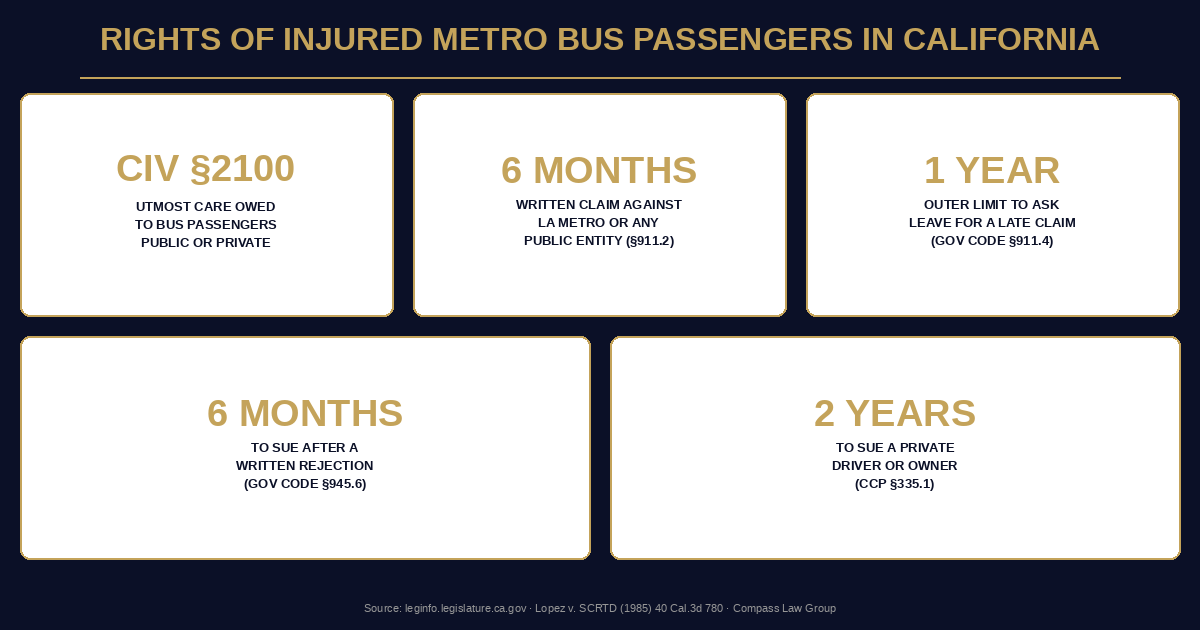
A claim against a public entity such as the Los Angeles County Metropolitan Transportation Authority must follow the California Government Claims Act, which imposes a short written-claim deadline before any lawsuit can be filed. Under Government Code section 911.2, a claim for personal injury or wrongful death against a public entity generally must be presented within six months after the claim accrues. That is a much shorter window than the two-year statute of limitations that usually applies to injury claims against private individuals under Code of Civil Procedure section 335.1.
The claim is an administrative step, not a lawsuit. Under Government Code section 910, it must show the claimant’s name and address, the date, place and other circumstances of the occurrence, a general description of the injury or loss, and the names of the public employees who caused it, if known. The agency generally has 45 days to act on the claim, and a claim it does not act on in time is deemed rejected (Government Code section 912.4). If the agency gives written notice rejecting the claim, a lawsuit generally must be filed no later than six months after that notice is personally delivered or deposited in the mail; if no written notice is given, the deadline is generally two years from when the claim accrued (Government Code section 945.6).
Missing the six-month deadline does not always end a claim, but it makes it much harder. A person may apply to the agency for leave to present a late claim, but the application must be made within a reasonable time — no later than one year after the claim accrued — and must state the reason for the delay (Government Code section 911.4). The agency must grant it only in the situations the law lists, such as mistake, inadvertence, surprise or excusable neglect that did not prejudice the agency, or a person who was a minor, was incapacitated, or died during the six-month period (Government Code section 911.6). Relying on that exception is risky.
Claims against a private driver follow a different path. They typically begin with the driver’s liability insurer, and a lawsuit, if needed, generally must be filed within two years (Code of Civil Procedure section 335.1). Because a single bus crash can involve both kinds of defendants, the practical rule is to plan around the shortest deadline — the public-entity claim — even before anyone knows whether the agency bears any responsibility. Presenting a timely claim preserves the right; it does not accuse anyone of wrongdoing.
Evidence in a transit crash also tends to be held by the agency: onboard and exterior camera footage, vehicle data, maintenance logs, operator records and dispatch communications. Written requests to preserve that evidence should be sent early, because routine retention schedules can overwrite video and electronic data.
What Can Families Do After a Passenger Is Killed in a Bus Crash?
When a passenger dies, California law allows two related claims: a wrongful death claim for the family’s own losses, and a survival claim on behalf of the person who died. These are distinct, and families are often surprised to learn both may exist.
Free Confidential Consultation — Compass Law Group, LLP | Chatsworth Metro Bus Crash: Rights of Injured Bus Passengers and Families in Los Angeles
Under Code of Civil Procedure section 377.60, a wrongful death claim may be brought by the person’s surviving spouse, domestic partner, children and the children of any deceased child — or, if there are no surviving descendants, by those who would inherit under California’s intestate succession rules. A putative spouse, the putative spouse’s children, stepchildren and parents may also bring the claim if they were dependent on the person, as may a minor who lived in the household for the previous 180 days and depended on the person for at least half of their support. It compensates the family for losses such as financial support the person would have provided, household services, and the loss of love, companionship, comfort, care and guidance.
A survival action is the person’s own claim, which passes on at death and is brought by the personal representative or, if there is none, the successor in interest (Code of Civil Procedure section 377.30). It recovers the losses the person sustained or incurred before death, such as medical expenses and lost earnings. Damages for the person’s own pain, suffering or disfigurement are generally not recoverable in a survival action; a temporary exception covered only actions filed on or after January 1, 2022 and before January 1, 2026 (Code of Civil Procedure section 377.34). Because that window has closed, families should get individualized advice about which damages remain available.
The deadlines described above apply to families too. A wrongful death claim against a public entity is subject to the same six-month presentation requirement, and a claim against a private party generally must be filed within two years of the death.
Families should also know that the timing of the criminal process does not control the civil one. In Chatsworth, the case is being forwarded to prosecutors, and no charges had been reported. Criminal cases can take many months or longer. A family can present a government claim and preserve evidence while the criminal process runs its course, and a civil attorney can coordinate with the prosecution rather than interfere with it.
No family should feel pressured to make decisions in the first days after a loss. But the deadlines are real, and a short conversation early can protect options for later. Our page on wrongful death claims in Los Angeles explains the process in more detail.
Does a Suspected DUI Change an Injury or Wrongful Death Case?
If a driver is ultimately shown to have been impaired, that evidence can strengthen a negligence claim and may open the door to punitive damages — but in Chatsworth, possible DUI is only a suspicion police have described, not a finding. The driver has not been convicted of anything, and no charges had been reported when NBC Los Angeles published its account.
In California civil cases, driving under the influence can support a finding of negligence, and a final judgment of conviction for a felony may be offered in a later civil case to prove facts essential to that judgment (Evidence Code section 1300). Separately, Civil Code section 3294 allows punitive damages when a plaintiff proves by clear and convincing evidence that a defendant acted with oppression, fraud or malice. In Taylor v. Superior Court (1979) 24 Cal.3d 890, the California Supreme Court held that operating a motor vehicle while intoxicated may constitute malice under section 3294 when it is done under circumstances showing a conscious disregard of the probable dangerous consequences. Punitive damages are not available in every case, and they cannot be recovered from a public entity such as LA Metro (Government Code section 818).
A suspected DUI also raises practical questions. Many individual auto policies carry limits far below the losses in a crash with multiple deaths and serious injuries, and insurers may dispute coverage. That is why uninsured and underinsured motorist coverage on the passengers’ own policies, or on household policies, is worth reviewing.
Crime victims may also be eligible for restitution if an offender is convicted, and for help with certain expenses through the California Victim Compensation Board, subject to its eligibility rules. Those programs work alongside a civil claim rather than replacing it. Our earlier article on car accidents caused by drunk drivers covers these issues in more depth.
The helicopter crash that evening is a separate matter: the NTSB is leading that investigation and had not determined a cause.
People harmed in transit and vehicle crashes across Southern California face many of the same questions. We previously wrote about the fatal tour bus fire on the 60 Freeway in Hacienda Heights, and our Los Angeles personal injury page lists the injury cases we handle in the region.
Evidence commonly gathered in a bus passenger injury or wrongful death claim includes:
- The official traffic collision report and any supplemental investigative reports;
- Bus onboard camera video and exterior camera footage;
- Traffic signal timing records for the intersection;
- Witness names and statements, including other passengers and nearby drivers;
- Medical records, imaging and treatment bills;
- Records from the criminal case, as they become available;
- Photographs of injuries, the scene and damaged property;
- Employment and wage records documenting lost income.
Rights of Injured Metro Bus Passengers in California | Source: leginfo.legislature.ca.gov · Lopez v. SCRTD (1985) 40 Cal.3d 780 · Compass Law Group
Source: Compass Law Group | Chatsworth Metro Bus Crash: Rights of Injured Bus Passengers and Families in Los Angeles

How Compass Law Group Builds Your Case
When Compass Law Group takes on a bus passenger injury or wrongful death matter, the first priority is protecting deadlines. We identify every potentially responsible party, calendar the six-month government-claim deadline for any public entity, and present claims before that window closes.
Next, we move to preserve evidence. Transit agencies and other parties hold video, vehicle data and maintenance records that may not be kept indefinitely, so we send written preservation demands early and request public records where the law allows.
We then build the damages picture carefully, working with treating physicians and, where appropriate, economic and medical experts, so that future care and lost earning capacity are documented rather than estimated. For families, we explain the difference between wrongful death and survival claims and who is entitled to bring each.
Where a criminal case is pending, we follow it closely and coordinate so the civil claim does not interfere with prosecutors’ work. Throughout, we communicate directly with clients about options and timing, and we do not pressure anyone to decide before they are ready.
Deadline warning: A claim against a California public entity, including a public transit agency, generally must be presented in writing no later than six months after the claim accrues — usually the date of the injury or death (Government Code section 911.2). Claims against private parties are generally subject to a two-year statute of limitations (Code of Civil Procedure section 335.1). Exceptions exist, and deadlines vary with the facts, so speak with a California attorney as soon as possible to confirm the deadlines that apply to your situation.
Frequently Asked Questions
Can I file a claim if I was a passenger on a bus that was hit by another vehicle?
Yes. A passenger who was hurt generally may seek compensation from the driver whose conduct caused the crash, and may have a claim against the bus operator if the evidence shows the operator or agency failed to meet the heightened duty of care owed to passengers. Passengers are not required to prove which party was at fault before seeking advice.
How long do I have to file a claim against LA Metro?
A written claim against a public entity such as LA Metro generally must be presented no later than six months after the claim accrues, usually the date of the injury (Government Code section 911.2). If the agency gives written notice rejecting the claim, a lawsuit generally must be filed within six months after that notice is delivered or mailed (Government Code section 945.6). An application to present a late claim must be made within a reasonable time, no later than one year after the claim accrued, and is granted only on grounds the law lists (Government Code sections 911.4 and 911.6).
Do I have to wait for the criminal case to finish before filing a civil claim?
No. Criminal and civil cases are separate proceedings with different purposes and different standards of proof. A civil claim can be presented and evidence preserved while prosecutors decide whether to file charges and while any criminal case proceeds.
Who can bring a wrongful death claim in California?
Under Code of Civil Procedure section 377.60, the surviving spouse, domestic partner and children may bring the claim — or, if there are no surviving descendants, the heirs under intestate succession — and dependent parents, stepchildren and putative spouses may also qualify. The personal representative may bring a separate survival action for losses the person sustained before death (Code of Civil Procedure section 377.30).
What if the at-fault driver does not have enough insurance?
Injured passengers may be able to turn to their own uninsured or underinsured motorist coverage, or coverage under a household member’s policy. Other responsible parties, if any are identified, may also carry insurance. A review of all available coverage early in the case helps avoid leaving compensation unclaimed.
Can I recover compensation if my injuries were not life-threatening?
Yes. Compensation is not limited to the most serious injuries. Medical bills, lost wages and pain and suffering from moderate injuries can all be recoverable. Some injuries worsen after the first few days, so a prompt medical evaluation and careful documentation matter.
Steps to Take After a Bus Crash Injury in Los Angeles
- Get medical care right away, even if your injuries seem minor, and follow through with any recommended follow-up treatment.
- Write down what you remember about the crash while it is fresh, including where you were seated and what you saw.
- Keep every medical record, bill, receipt and document related to your injuries and lost work.
- Photograph your injuries and any damaged belongings, and keep the damaged items if possible.
- Collect names and contact information for other passengers or witnesses you are in touch with.
- Avoid giving recorded statements to insurance companies or signing releases before you understand your rights.
- Avoid posting about the crash or your injuries on social media.
- Calendar the six-month deadline for any claim against a public agency, and speak with an attorney well before it arrives.
Get Your Free Consultation Today
No Win, No Fee — Compass Law Group, LLP | Call (213) 320-1001
If you or someone you love was injured or killed in a bus crash in Los Angeles County, Compass Law Group can review your situation, explain the deadlines that apply, and help you understand your options. There is no obligation, and the conversation is confidential. Reach out to our team to schedule your free consultation.
References
- NBC Los Angeles, September 16, 2026. https://www.nbclosangeles.com/news/local/chatsworth-bus-crash-arrest/3942960/
- NBC News, September 16, 2026. https://www.nbcnews.com/news/us-news/helicopter-crashes-los-angeles-chatsworth-rcna598061
- San Bernardino Sun (Southern California News Group), Nathaniel Percy, September 16, 2026. https://www.sbsun.com/2026/09/16/2-dead-6-hospitalized-after-suv-crashes-into-metro-bus-in-chatsworth-driver-arrested/
- Metro Magazine, “Metrolink offers $200M settlement to Chatsworth victims”, August 26, 2010. https://www.metro-magazine.com/news/metrolink-offers-200m-settlement-to-chatsworth-victims
- NBCLA (YouTube), “2 dead, 6 hospitalized after SUV crashes into Metro bus in Chatsworth”, September 15, 2026. https://www.youtube.com/watch?v=QWvi5A7smTk
- NBC DFW (YouTube), “Helicopter providing coverage for NBC L.A. crashes, killed 3 | NBCDFW”, September 16, 2026. https://www.youtube.com/watch?v=dpnPUI_j904
- Cal. Civ. Code § 2100. https://leginfo.legislature.ca.gov/faces/codes_displaySection.xhtml?lawCode=CIV§ionNum=2100
- Lopez v. Southern California Rapid Transit Dist. (1985) 40 Cal.3d 780. https://static.case.law/cal-3d/40/html/0780-01.html
- Li v. Yellow Cab Co. (1975) 13 Cal.3d 804. https://static.case.law/cal-3d/13/html/0804-01.html
- Cal. Veh. Code § 17150. https://leginfo.legislature.ca.gov/faces/codes_displaySection.xhtml?lawCode=VEH§ionNum=17150
- Cal. Gov. Code § 835. https://leginfo.legislature.ca.gov/faces/codes_displaySection.xhtml?lawCode=GOV§ionNum=835
- Cal. Gov. Code § 910. https://leginfo.legislature.ca.gov/faces/codes_displaySection.xhtml?lawCode=GOV§ionNum=910
- Cal. Gov. Code § 911.2. https://leginfo.legislature.ca.gov/faces/codes_displaySection.xhtml?lawCode=GOV§ionNum=911.2
- Cal. Gov. Code § 911.4. https://leginfo.legislature.ca.gov/faces/codes_displaySection.xhtml?lawCode=GOV§ionNum=911.4
- Cal. Gov. Code § 911.6. https://leginfo.legislature.ca.gov/faces/codes_displaySection.xhtml?lawCode=GOV§ionNum=911.6
- Cal. Gov. Code § 912.4. https://leginfo.legislature.ca.gov/faces/codes_displaySection.xhtml?lawCode=GOV§ionNum=912.4
- Cal. Gov. Code § 945.6. https://leginfo.legislature.ca.gov/faces/codes_displaySection.xhtml?lawCode=GOV§ionNum=945.6
- Cal. Code Civ. Proc. § 335.1. https://leginfo.legislature.ca.gov/faces/codes_displaySection.xhtml?lawCode=CCP§ionNum=335.1
- Cal. Code Civ. Proc. § 377.30. https://leginfo.legislature.ca.gov/faces/codes_displaySection.xhtml?lawCode=CCP§ionNum=377.30
- Cal. Code Civ. Proc. § 377.34. https://leginfo.legislature.ca.gov/faces/codes_displaySection.xhtml?lawCode=CCP§ionNum=377.34
- Cal. Code Civ. Proc. § 377.60. https://leginfo.legislature.ca.gov/faces/codes_displaySection.xhtml?lawCode=CCP§ionNum=377.60
- Cal. Civ. Code § 3294. https://leginfo.legislature.ca.gov/faces/codes_displaySection.xhtml?lawCode=CIV§ionNum=3294
- Cal. Gov. Code § 818. https://leginfo.legislature.ca.gov/faces/codes_displaySection.xhtml?lawCode=GOV§ionNum=818
- Cal. Evid. Code § 1300. https://leginfo.legislature.ca.gov/faces/codes_displaySection.xhtml?lawCode=EVID§ionNum=1300
- Taylor v. Superior Court (1979) 24 Cal.3d 890. https://static.case.law/cal-3d/24/html/0890-01.html
- 49 U.S.C. § 28103. https://uscode.house.gov/view.xhtml?req=granuleid:USC-prelim-title49-section28103&num=0&edition=prelim