


A pedestrian died after being struck by a vehicle in Eastvale, in Riverside County, on Friday, November 27, 2026. According to MyNewsLA, citing the Riverside County Sheriff’s Department, the collision was reported at 11:32 a.m. on Eastvale Parkway and Corona Valley Avenue. KTLA reports that deputies found the pedestrian unresponsive on the roadway. Paramedics pronounced the person dead at the scene. The driver remained at the scene and is cooperating with investigators, and the cause of the collision remains under investigation.
Compass Law Group, LLP does not represent anyone involved in this collision and is not investigating it. This post sets out what the two news reports say, what they leave unanswered, and the California statutes that families generally need to know about after a fatal pedestrian crash.
- Both reports say the driver stayed at the scene and is cooperating, and that the cause of the collision is still under investigation.
- The reports do not say whether the pedestrian was in a crosswalk, so they do not show which Vehicle Code rule applies.
- Code of Civil Procedure section 377.60 lists the family members who may assert a wrongful-death claim in California.
- Code of Civil Procedure section 335.1 sets a two-year period for an action for a death caused by the wrongful act or neglect of another.
After a fatal pedestrian crash in California, certain family members may bring a wrongful-death claim if the death was caused by another’s wrongful act or neglect. The general filing deadline is two years, and the Eastvale reports do not say what caused this collision.
What Do the Reports Say About the Eastvale Parkway Crash?
Two news reports describe the collision. MyNewsLA, citing the Riverside County Sheriff’s Department, says it was reported at 11:32 a.m. on Friday, November 27, 2026, on Eastvale Parkway and Corona Valley Avenue. KTLA, in a report republished on Yahoo News, says deputies from the Jurupa Valley Sheriff’s Station were called to a crash at Eastvale Parkway and Corona Valley Avenue just after 11:32 a.m.
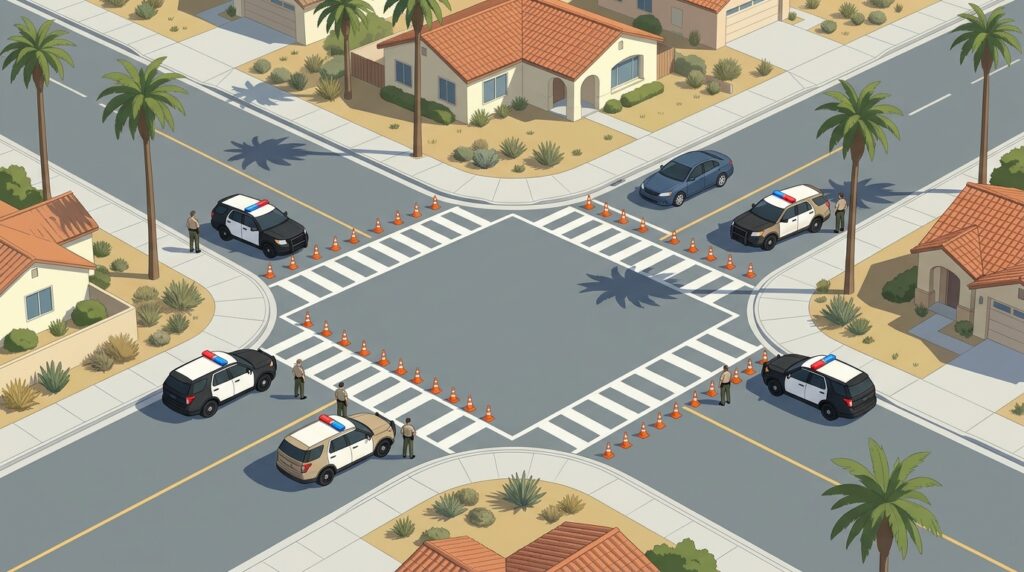
Both reports say deputies found the pedestrian unresponsive. KTLA describes the person as lying unresponsive on the roadway. MyNewsLA reports that deputies attempted life-saving measures until paramedics arrived, and that paramedics pronounced the person dead at the scene.
Both reports also say the driver remained at the scene and is cooperating with investigators, and that the cause of the collision remains under investigation. On impairment, KTLA reports that authorities said it did not appear that alcohol or drugs were a factor. MyNewsLA reports that authorities said there was no suspicion of alcohol or drug use. KTLA adds that the pedestrian’s identity is being withheld pending notification of next of kin.
What the reports leave out matters as much as what they include. The reports do not say who the pedestrian or the driver is. They do not say where on the roadway the pedestrian was, what the pedestrian was doing, or how the collision happened. Those are the facts the legal rules below turn on, and the investigating agency has not announced them. Nothing in either report supports a conclusion that the driver or the pedestrian was responsible for what happened, and this post does not draw one.
Investigators are still gathering information. KTLA reports that anyone who witnessed the collision or has information is asked to call Deputy Vawter at 951-955-2600 or Riverside County Sheriff’s Office dispatch at 951-776-1099. A witness account given directly to the investigating agency is the most useful thing a member of the public can offer at this stage. Families waiting for answers should expect the official findings, not the first news reports, to settle the open questions.
What Does California Law Say About Drivers and Pedestrians?
California’s Vehicle Code has two rules about drivers and pedestrians, and they have to be read together. Which one governs depends on where the pedestrian was. The reports do not say where the pedestrian was, so they do not say which rule applies to the Eastvale collision.
The first is Vehicle Code section 21950. Subdivision (a) says the driver of a vehicle shall yield the right-of-way to a pedestrian crossing the roadway within any marked crosswalk or within any unmarked crosswalk at an intersection, except as otherwise provided. Subdivision (b) says this does not relieve a pedestrian from the duty of using due care. No pedestrian may suddenly leave a curb or other place of safety and walk or run into the path of a vehicle that is so close as to constitute an immediate hazard. Subdivision (c) requires a driver approaching a pedestrian within any marked or unmarked crosswalk to exercise all due care and to reduce speed or take any other action necessary to safeguard the pedestrian. Subdivision (d) says subdivision (b) does not relieve a driver of the duty of due care for a pedestrian in a marked crosswalk or an unmarked crosswalk at an intersection. Compass explains the section in more detail in its guide to Vehicle Code 21950 and pedestrian right-of-way.
The second is Vehicle Code section 21954. Subdivision (a) says a pedestrian upon a roadway at any point other than within a marked crosswalk or an unmarked crosswalk at an intersection shall yield to all vehicles so near as to constitute an immediate hazard. Subdivision (b) says this does not relieve the driver of the duty to exercise due care for the safety of any pedestrian upon a roadway.
Read together, the two sections place duties of care on both drivers and pedestrians, inside a crosswalk and outside one. Neither section, by itself, decides who is responsible for a particular collision. That depends on facts such as position, timing and conduct, which the investigating agency has not announced here.
Behind both sections sits the general rule in Civil Code section 1714, subdivision (a). Everyone is responsible for an injury to another caused by want of ordinary care or skill in the management of their property or person, except so far as the injured person, willfully or by want of ordinary care, brought the injury upon themself.
Who Can Bring a Wrongful Death Claim in California?
California does not allow every relative or friend to bring a wrongful-death claim. Code of Civil Procedure section 377.60 lists who may assert one. This is general guidance for families. The reports do not identify the pedestrian or any relatives, and nothing here suggests that a claim exists in the Eastvale case.
Under section 377.60, a wrongful-death claim may be asserted by the decedent’s surviving spouse, domestic partner, children, and the issue of deceased children. If there is no surviving issue, the claim may be asserted by the persons who would be entitled to the decedent’s property by intestate succession. That group includes the surviving spouse or domestic partner. The decedent’s personal representative may also bring the claim on behalf of these people.
The statute then names people who may assert a claim if they were dependent on the decedent:
The putative spouse, children of the putative spouse, stepchildren, and parents qualify if they were dependent on the decedent. Legal guardians qualify on the same condition if the parents are deceased. Section 377.60 also covers a minor who lived in the decedent’s household for the previous 180 days and depended on the decedent for one-half or more of the minor’s support.
In practice, the first question for a family is often who holds the right to bring the claim, not whether one can be brought. The answer depends on the family’s actual structure. It turns on whether there is a spouse or domestic partner, whether there are children or grandchildren, and whether anyone else was financially dependent on the person who died. Two families who suffer the same loss can have different answers under the statute.
Because the list is set by statute, questions about who qualifies are usually answered from documents. Marriage or domestic partnership records, birth records and proof of financial support are the usual sources. Families gathering information after a loss may find it useful to keep those records together. Compass describes how these claims work on its Los Angeles wrongful death attorney page. An attorney reviewing a specific family’s situation is the right person to say how section 377.60 applies to it.
What Is the Difference Between a Wrongful Death Claim and a Survival Action?
California law recognizes two separate kinds of civil action after a death, and families often hear the two terms used as if they meant the same thing. They do not. A wrongful-death claim under section 377.60 belongs to the surviving family members the statute lists. A survival action is the decedent’s own cause of action, carried forward after death.

Free Confidential Consultation — Compass Law Group, LLP
Code of Civil Procedure section 377.30 says a cause of action that survives the death of the person entitled to bring it passes to the decedent’s successor in interest. An action may be commenced by the decedent’s personal representative or, if there is none, by the decedent’s successor in interest. The person who brings a survival action is therefore standing in for the person who died, not suing in their own right.
Code of Civil Procedure section 377.34 limits what can be recovered in that kind of action. Damages are limited to the loss or damage the decedent sustained or incurred before death. They include any punitive damages the decedent would have been entitled to recover had the decedent lived. They do not include damages for pain, suffering or disfigurement.
The statute contains an exception, and its dates matter. Subdivision (b) covers actions that were granted a preference under Section 36 before January 1, 2022, and actions filed on or after January 1, 2022, and before January 1, 2026. An action filed now falls outside that filing window. Families who have read older articles about survival actions should check which dates the article was written under.
The distinction has practical consequences. It affects who must be named as the person bringing the action. It affects whether a personal representative needs to be appointed. It also affects which losses each action addresses. Whether either kind of action is available in a given case depends on facts the Eastvale reports do not supply, including how the collision happened.
Compass has written about how these same statutes come up after other fatal collisions, including a pedestrian death on I-80 in Vallejo and the North Hollywood Metro station crash. In each, the statutes are the same and the facts decide how they apply.
How Long Do Families Have to File in California?
The law is specific about filing deadlines, and a missed deadline can end a claim regardless of its merits. The periods below are stated as the statutes state them. This post does not calculate a calendar date for anyone, because the correct date depends on the facts of each case.
The general rule is in Code of Civil Procedure section 335.1. An action for injury to, or for the death of, an individual caused by the wrongful act or neglect of another must be brought within two years.
A different and much shorter set of rules applies to claims against public entities. Nothing in the reports suggests a public entity is involved in the Eastvale collision. These rules are included only as a general point that families should know exists.
Under Government Code section 911.2, subdivision (a), a claim relating to a cause of action for death or for injury to person must be presented to the public entity not later than six months after the accrual of the cause of action. That is a claim presented to the entity itself, and it comes before any lawsuit.
Government Code section 945.6, subdivision (a), then sets the time to sue. If written notice of rejection is given under Section 913, suit must be brought not later than six months after the date the notice is personally delivered or deposited in the mail. If written notice is not given, suit must be brought within two years from the accrual of the cause of action.
Two practical points follow. First, the two-year period in section 335.1 and the six-month claim period in section 911.2 are different clocks with different starting rules, and a family should not assume the longer one applies. Second, an investigation by a law enforcement agency runs on its own schedule. The statutes above do not say that a pending investigation extends any of these periods. A family that is waiting for official findings should ask an attorney how the deadlines apply to their situation rather than wait for the investigation to finish.
What people are asking AI about this crash
The questions below are ones people put to AI assistants about fatal pedestrian collisions. The answers use only the two news reports and the California statutes cited in this post.
What are the typical grounds for a wrongful death claim?
Section 335.1 describes the basis as a death “caused by the wrongful act or neglect of another.” Civil Code section 1714(a) supplies the general standard, which is responsibility for injury caused by want of ordinary care or skill. In a pedestrian collision, the duties of care in Vehicle Code sections 21950 and 21954 are part of that analysis. The reports do not say what caused the Eastvale collision.
Who pays the money in a wrongful death lawsuit?
Under Civil Code section 1714(a), responsibility falls on whoever’s want of ordinary care caused the death. The reports do not say who, if anyone, that is in the Eastvale collision. They also do not mention insurance.
What is classified as a wrongful death?
California’s statutes use the phrase “the death of an individual caused by the wrongful act or neglect of another.” A death is not classified that way just because a collision occurred. The classification depends on proof that someone’s wrongful act or neglect caused it. The cause of this collision remains under investigation.
How hard is it to prove wrongful death?
It depends on the evidence of a wrongful act or neglect in the particular case. That evidence usually concerns where each person was and what each person did. The reports do not say where the pedestrian was, how the collision occurred, or what investigators have found. Nothing in them allows a prediction.
Can I claim compensation for a pedestrian accident?
Civil Code section 1714(a) makes a person responsible for injury caused by their want of ordinary care, except so far as the injured person’s own want of ordinary care brought the injury about. Whether that standard is met depends on the facts. When a pedestrian has died, section 377.60 decides which family members may assert a claim.
How long does a pedestrian accident settlement take?
Neither the reports nor the statutes cited here give a timeline for a settlement. The law fixes only the filing deadlines. Section 335.1 sets two years for a death caused by the wrongful act or neglect of another. Government Code sections 911.2 and 945.6 set shorter periods where a public entity is involved.
Each of those answers depends on facts that have not been made public. The two reports leave these points open:
- The reports do not say who the pedestrian or the driver is, and they do not give the pedestrian’s age.
- The reports do not say whether the pedestrian was in a crosswalk, crossing, or standing.
- The reports do not say which direction anyone was travelling, what type of vehicle was involved, or how fast it was going.
- The reports do not say what any traffic signal was showing.
- The reports do not say whether anyone was cited or arrested.
- The reports do not say whether any road condition or public entity played a part.
- The reports do not say whether the driver had insurance or was working at the time.
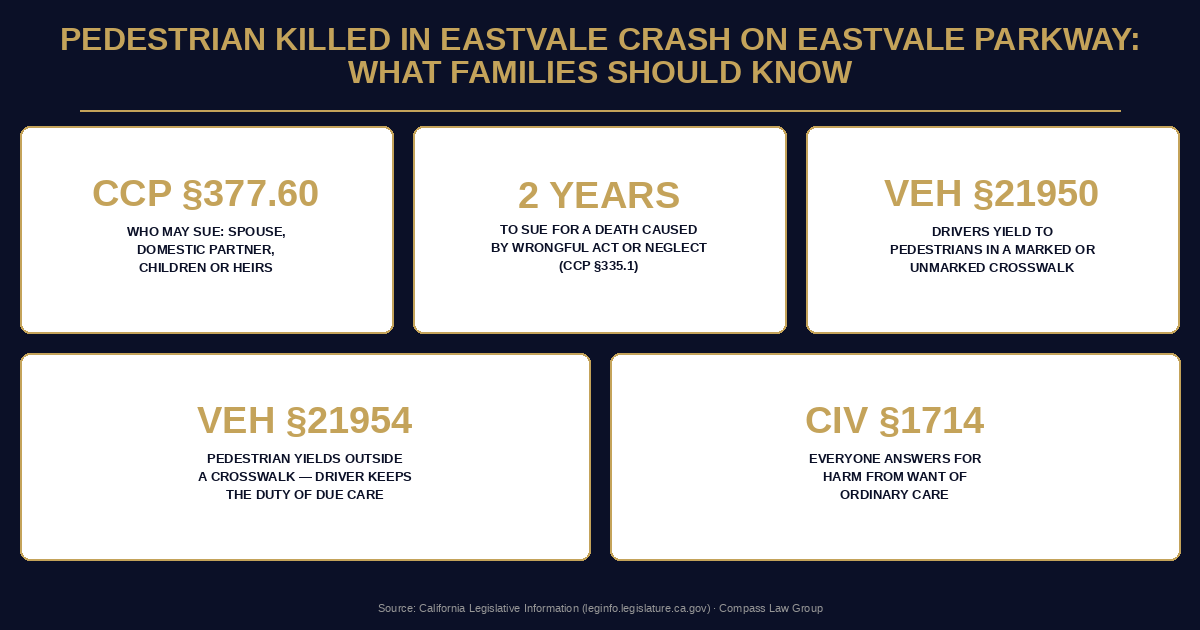
Pedestrian Killed in Eastvale Crash on Eastvale Parkway: What Families Should Know | Source: California Legislative Information (leginfo.legislature.ca.gov) · Compass Law Group
How Compass Law Group Builds Your Case
Compass Law Group, LLP is a California personal injury firm. It does not represent anyone involved in the Eastvale collision and is not investigating it. This section describes in general terms how the firm approaches a fatal pedestrian case when a family asks for help.
The work starts with the record. That means obtaining the investigating agency’s report once it is available, identifying the witnesses it names, and finding out what physical and documentary evidence exists and who holds it. The firm does not treat a news report as a finding. The open questions listed above are the kind it looks to the official investigation and the evidence to answer.
The firm then applies the statutes to the facts. It reads Vehicle Code sections 21950 and 21954 against where the pedestrian was. It applies Civil Code section 1714 to the conduct of everyone involved. It uses Code of Civil Procedure section 377.60 to determine which family members may assert a claim. It also considers whether a survival action under sections 377.30 and 377.34 is available alongside one.
Deadlines are tracked from the first conversation. These include the two-year period in section 335.1 and, where a public entity may be involved, the six-month claim period in Government Code section 911.2. The firm also tells a family plainly when the facts do not support a claim.
More about the firm’s work is on the Compass Law Group Los Angeles page and the Los Angeles pedestrian accident lawyer page.
Statute of limitations warning. Under Code of Civil Procedure section 335.1, an action for the death of an individual caused by the wrongful act or neglect of another must be brought within two years. Claims against a public entity follow shorter rules. Under Government Code section 911.2(a), a claim for death or injury to person must be presented to the public entity not later than six months after the accrual of the cause of action. Under Government Code section 945.6(a), if written notice of rejection is given, suit must be brought not later than six months after the notice is personally delivered or deposited in the mail. If written notice is not given, suit must be brought within two years from the accrual of the cause of action. Nothing in the reports suggests a public entity is involved in the Eastvale collision. This is general information, not legal advice about any particular deadline.
Frequently Asked Questions
Has the pedestrian in the Eastvale crash been identified?
No. KTLA reports that the pedestrian’s identity is being withheld pending notification of next of kin. The reports do not give the person’s name or age.
Did authorities say alcohol or drugs were involved?
KTLA reports that authorities said it did not appear that alcohol or drugs were a factor. MyNewsLA reports that authorities said there was no suspicion of alcohol or drug use. Both reports say the cause of the collision remains under investigation.
Who should witnesses contact?
KTLA reports that anyone who witnessed the collision or has information is asked to call Deputy Vawter at 951-955-2600 or Riverside County Sheriff’s Office dispatch at 951-776-1099.
Does it matter whether a pedestrian was in a crosswalk?
It affects which Vehicle Code section applies. Section 21950 covers a pedestrian crossing within a marked crosswalk or an unmarked crosswalk at an intersection. Section 21954 covers a pedestrian on the roadway at any other point. Both sections keep the driver’s duty of due care in place. The reports do not say where the pedestrian was.
Can parents bring a wrongful death claim in California?
Section 377.60 allows parents to assert a claim if they were dependent on the decedent. Parents may also qualify where there is no surviving issue and they would be entitled to the decedent’s property by intestate succession. The answer depends on the family’s circumstances.
Does Compass Law Group represent anyone involved in this crash?
No. Compass Law Group does not represent the pedestrian’s family, the driver, or anyone else involved, and it is not investigating the collision. This post is general information based on two news reports and the cited statutes.
Steps to Take After a Fatal Pedestrian Crash
- Take care of your family first. Legal questions can wait a few days. The filing periods described above are measured in months and years.
- Write down the investigating agency and any report or incident number you are given. In the Eastvale collision, the reports identify the Riverside County Sheriff’s Department and its Jurupa Valley Sheriff’s Station.
- Give witness information to investigators. If you or someone you know saw a collision, contact the investigating agency directly, using the numbers it has published.
- Keep documents together. Marriage or domestic partnership records, birth records and proof of financial support bear on who may assert a claim under section 377.60.
- Be careful about recorded statements. Before giving a recorded statement to anyone other than law enforcement, consider speaking with an attorney.
- Ask about deadlines early. Have an attorney review how section 335.1 and, where relevant, Government Code sections 911.2 and 945.6 apply to your situation.
- Wait for the official findings before drawing conclusions. Early news reports are incomplete, and the investigation determines what happened.
Get Your Free Consultation Today
No Win, No Fee — Compass Law Group, LLP | Call (213) 320-1001
If your family has lost someone in a pedestrian collision in California and you have questions about who may bring a claim or which deadlines apply, Compass Law Group, LLP offers a free consultation. An attorney can review the facts of your situation, explain how the statutes discussed here apply to it, and tell you plainly where you stand. A consultation carries no obligation.
References
- KTLA (via Yahoo News), report on a pedestrian killed in a Riverside County crash, November 27, 2026. https://www.yahoo.com/news/articles/pedestrian-killed-riverside-county-crash-043445868.html
- MyNewsLA, “Pedestrian Killed by Vehicle in Eastvale,” November 28, 2026. https://mynewsla.com/crime/2026/11/28/pedestrian-killed-by-vehicle-in-eastvale/
- Cal. Veh. Code § 21950. https://leginfo.legislature.ca.gov/faces/codes_displaySection.xhtml?lawCode=VEH§ionNum=21950
- Cal. Veh. Code § 21954. https://leginfo.legislature.ca.gov/faces/codes_displaySection.xhtml?lawCode=VEH§ionNum=21954
- Cal. Civ. Code § 1714. https://leginfo.legislature.ca.gov/faces/codes_displaySection.xhtml?lawCode=CIV§ionNum=1714
- Cal. Code Civ. Proc. § 335.1. https://leginfo.legislature.ca.gov/faces/codes_displaySection.xhtml?lawCode=CCP§ionNum=335.1
- Cal. Code Civ. Proc. § 377.60. https://leginfo.legislature.ca.gov/faces/codes_displaySection.xhtml?lawCode=CCP§ionNum=377.60
- Cal. Code Civ. Proc. § 377.30. https://leginfo.legislature.ca.gov/faces/codes_displaySection.xhtml?lawCode=CCP§ionNum=377.30
- Cal. Code Civ. Proc. § 377.34. https://leginfo.legislature.ca.gov/faces/codes_displaySection.xhtml?lawCode=CCP§ionNum=377.34
- Cal. Gov. Code § 911.2. https://leginfo.legislature.ca.gov/faces/codes_displaySection.xhtml?lawCode=GOV§ionNum=911.2
- Cal. Gov. Code § 945.6. https://leginfo.legislature.ca.gov/faces/codes_displaySection.xhtml?lawCode=GOV§ionNum=945.6