





Under California Vehicle Code § 21950, a driver must yield the right-of-way to a pedestrian crossing in a marked or unmarked crosswalk at an intersection. A driver who fails to yield and injures a pedestrian is typically negligent — though pedestrians must also use due care for their own safety.
Reviewed against the current statutory text at leginfo.legislature.ca.gov. This page is legal information, not legal advice.
Exact Statute Text
21950. (a) The driver of a vehicle shall yield the right-of-way to a pedestrian crossing the roadway within any marked crosswalk or within any unmarked crosswalk at an intersection…
(b) This section does not relieve a pedestrian from the duty of using due care for their safety. No pedestrian may suddenly leave a curb or other place of safety and walk or run into the path of a vehicle that is so close as to constitute an immediate hazard…
(c) The driver of a vehicle approaching a pedestrian within any marked or unmarked crosswalk shall exercise all due care and shall reduce the speed of the vehicle or take any other action… to safeguard the safety of the pedestrian.
Read the full, current section at the official source: Cal. Veh. Code § 21950 (leginfo).
In Plain English
- Drivers must yield to pedestrians in marked or unmarked crosswalks at intersections.
- Extra care required: drivers must slow down and take action to protect pedestrians in a crosswalk.
- Pedestrians share a duty: they must use due care and cannot dart suddenly into traffic — which can reduce recovery under comparative fault.
- Negligence per se: a driver’s violation of § 21950 is strong evidence of negligence in an injury claim.
Key Terms Defined
Right-of-way
The legal priority to proceed; § 21950 gives it to pedestrians in a crosswalk.
Unmarked crosswalk
The crossing area at an intersection even without painted lines — still protected under § 21950.
Negligence per se
Violating a safety statute like § 21950 is treated as evidence of negligence.
Comparative fault
A pedestrian’s own lack of due care can reduce, but not necessarily eliminate, their recovery.
Purpose & Context
Section 21950 protects people on foot by requiring drivers to yield and slow down at crosswalks, while recognizing that pedestrians must also act reasonably. It is the central rule in most pedestrian-accident liability disputes.
Real-World Example
A driver turning at an intersection strikes a pedestrian lawfully in an unmarked crosswalk. Under § 21950, the driver’s failure to yield is strong evidence of negligence; if the pedestrian stepped out suddenly, comparative fault may reduce the recovery.
Vehicle Code § 21950 at a glance
| Party | Duty |
|---|---|
| Driver | Yield to pedestrians in marked/unmarked crosswalks; slow down; use all due care |
| Pedestrian | Use due care; do not dart suddenly into the path of a close vehicle |
| On violation | Treated as negligence per se in a civil claim |
| Shared fault | Comparative fault can reduce a pedestrian’s recovery |
Related California Statutes
Why 21950 Matters
For injured people & families
A driver’s failure to yield in a crosswalk is often the key to proving fault — and comparative fault rarely bars a pedestrian’s claim entirely. See our California pedestrian accident lawyer page.
For defendants
Whether the pedestrian was in a crosswalk and used due care is central; comparative fault is the usual defense.
Frequently Asked Questions
Does a driver always have to yield to a pedestrian?
Under Vehicle Code § 21950, drivers must yield to pedestrians in marked and unmarked crosswalks at intersections and exercise all due care.
What if I was jaywalking?
A pedestrian’s own lack of due care can reduce recovery under comparative fault, but California still allows a claim reduced by your share of fault.
Is there a crosswalk if there are no painted lines?
Yes. An unmarked crosswalk generally exists at intersections and is protected under § 21950.
How long do I have to file?
Generally two years from the injury (CCP § 335.1); six months if a government vehicle or entity is involved.

Joseph Shirazi — Managing Partner · California State Bar #265403
Joseph Shirazi is the Managing Partner of Compass Law Group, LLP, representing injury and abuse survivors throughout California.
Verified profiles: Avvo · Super Lawyers · Justia · Elite Lawyer · LinkedIn · CA State Bar
Legally reviewed by Simon Esfandi, Partner & Co-Founder (CA Bar #275307).
Disclaimer: This page provides general legal information about California law and is not legal advice. Reading it does not create an attorney-client relationship. Past results do not guarantee future outcomes.

Meet Our Managing Partners
National Top 100 Trial Lawyers and Avvo 10.0 Superb. Loyola Law School graduate. Recognized for his $14,500,000 truck accident verdict and a $13,000,000 trial verdict.
Read Full Bio →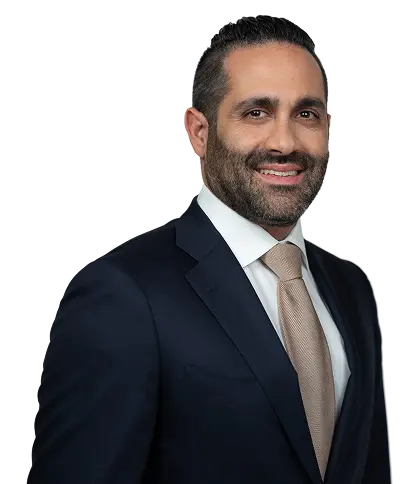
Super Lawyers Rising Star. Southwestern Law School graduate. Led the firm’s $9,870,000 motorcycle accident settlement and a $2,250,000 rideshare recovery.
Read Full Bio →- ★ National Top 100 Trial Lawyers
- ★ Super Lawyers Rising Star
- ★ Avvo 10.0 Superb Rating
- ★ Top 40 Under 40
- ★ Consumer Attorneys of California · CAALA · AAJ